Dear Readers of Cookbook Of the Day:
I am sorry to pass along the sad news that Lucinda Ebersole passed away on March 20, 2017 after a three month fight with cancer.
Lucinda loved writing these posts but was unable to do so the past several months.
I hope that you enjoyed reading her posts over the last few years.
Best,
Ann
12 April 2017

06 September 2016
Requiescat in Pace -- Vertamae Smart-Grosvenor

01 August 2016
I Love Curry

Yes, I love curry, too. Alas, it is one of those items that often seem to be a bit complicated. On more than one occasion, I have reverted to a generic curry powder. I find curry recipes are often incredibly long and on any given occasion, I have about half the spices. While surfing Twitter, I ran across a recommendation for this book, I Love Curry by Anjum Anand.
Anjum is a frequent BBC presenter with several books under her belt. She also has a brand of mixed curry spices that one can find on Amazon, but not in most grocery stores.
This book is a great introduction to making curry. Yes, the recipes have a lot of ingredients, but many of them are already in your pantry. You will need to read your recipe very carefully and you might need a day to gather all your ingredients, but for most part, the recipes are easy to replicate. There is a good mix of spicy and mild recipes, both meat and vegetarian, so there is something for everyone.
Here is her take on a spicy lamb curry that is very nice, a bit spicy.
Spicy Lamb, Tomato, and Coconut Curry
1 tbsp coriander seeds
1 tsp cumin seeds
15 black peppercorns
5cm cinnamon stick
4 cloves
500g boneless or 600g bone-in lamb leg or shoulder, cubed
3 small onions, finely chopped
3 tomatoes, chopped
15g ginger, peeled weight, grated into a paste
8 fat garlic cloves, grated into a paste
3-6 green chillies, whole but pierced
Salt, to taste
2 tbsp ghee, or vegetable oil and butter
200-300ml coconut milk, or to taste
1½ tsp lemon juice, or to taste
Using a spice grinder or a good mortar and pestle, pound the whole spices to a fine powder.
Place the lamb, two of the chopped onions, tomatoes, ginger, garlic, chillies, spices and salt in a large saucepan. Add 500ml water, bring to a boil, then cover and cook gently for 45-60 minutes, or until the lamb is cooked and tender. Give the pot a stir every 10 minutes or so.
After about 45 minutes, melt the ghee in a small saucepan and fry the remaining onion until well browned.
There shouldn’t be too much liquid left in the pan once the lamb is cooked. Cook off any excess moisture in the pan over a high flame for six or seven minutes, stirring quite often, until the sauce has mostly been absorbed by the lamb. This bhunoing process will help homogenise the sauce and deepen the flavours. Add the browned onion and ghee.
Pour in the coconut milk and lemon juice, bring to a boil and simmer for five minutes; the sauce should be thick and creamy. Taste and adjust the seasoning, adding lemon juice or coconut milk until the dish is perfect for you, then serve.
I do love getting recommendations from the Internet! This one was a winner.
25 July 2016
Cooking Wild

He and James Fraioli's new book, Cooking Wild offers up more than 150 recipes "for eating close to nature." Ash's grandmother taught him to forage as a child. He relished the books of Euell Gibbon's and Billy Joe Tatum. And while the book advocates foraging, Ash points out that in this day and age, many wild foods can be found in local groceries.
While one does not always need to be out in the wild searching for ingredients, it is important to use the same due diligence in the grocery store as one does in the wild. Buy local and seasonal. Buy sustainable. Above all else, be simple, let the food speak for itself.
The great thing about this book is the dual nature of the book. Yes, you can grab your copy of Euell Gibbons and head out into the woods, but the recipes are also written to allow the average couch potato to have his couch and eat his potatoes, too, or maybe asparagus.
Grilled Asparagus with Lemon Olive Oil, Pecorino, and ProsciuttoGo forth and forage.
1 pound fresh asparagus, trimmed
2 tablespoons extra virgin olive oil
Flaky sea salt such as Maldon
Freshly ground black pepper
3 tablespoons or so Italian or California lemon infused extra virgin olive oil
2 ounces pecorino or Parmigiano-Reggiano cheese, thinly shaved with a vegetable peeler
8 very thin slices prosciutto
2 tablespoons drained capers, patted dry and fried in olive oil until crisp
Lemon wedges, for serving
Prepare a charcoal grill or preheat a gas grill for medium high.
Brush the asparagus with the extra-virgin olive oil and season generously with salt and pepper to taste. Grill the asparagus, turning as needed, until lightly browned on all sides but still green and crisp. Place on a plate and drizzle with lemon olive oil. Scatter the cheese over the asparagus, arrange the prosciutto attractively on top, and sprinkle with the capers. Serve with the lemon wedges.
20 July 2016
A Super Upsetting Cookbook About Sandwiches

Tyler Kord has a few sandwich shops in NYC or perhaps "restaurants" since Bon Appétit named one of them as a top ten new restaurant in the country. What you need to know about Tyler Kord is that he is unnaturally in love with broccoli and Van's made a shoe for him. (Yes, you can buy your own pair, if you have the dough.)
As someone who has read thousands of cookbooks, I can tell you that many of those that rise from the back rooms of restaurants are pompous. Yes, chefs do "write" them on occasion, but in an attempt to describe that grand world of restaurant cooking, the voice is often pretentious or really just tool-y. Kord is not pretentious.
He understands that he is making sandwiches. He will not be making you a BLT. He might make you a sandwich with curry chicken salad and squid. He might make you a sandwich with black bean hummus and ceviche. He might make you sandwich named after a battle. As you read through the book, you will think about sandwiches differently. (Really, roasted cauliflower and a raisin scallion sauce?) You will think about food differently. (Do lychees and broccoli really go together?) You will even think about cookbooks differently. (Who chats with their editor in the middle of a cookbook?)
Now here is where we put a recipe from the cookbook. There are so many sandwiches, but... one of our favorite things in the world is a jar of pickled blueberries. Every year I get 10 pound boxes of blueberries from a farm in Maryland. After eating a pound right out of the box, there are jams, jellies, catsup, pies, tarts, shrubs, and finally, several jars of pickled blueberries. So herewith, Kord's recipe.
Pickled BlueberriesKord suggests they make a fine replacement for tomatoes on your sandwich. So make yourself a BLB while reading A Super Upsetting Cookbook About Sandwiches.
1 cup white vinegar, plus some more if needed
1/4 cup sugar
1 3/4 tablespoons kosher salt
1 1/4 pounds blueberries
1 small red onion, halved and thinly sliced
Combine everything in a plastic container with a tight fitting lid. There should be enough vinegar to completely cover the berries and onions, if not, add a little more. Pretend it is those pickled red onions that you hate so much and shale vigorously. You want to bruise the berries a little and also get out some aggression you feel toward your roommate. Why would you still have a roommate? Why do you hate pickled red onions so much? Let sit for at least 2 hours, but preferably longer, shaking occasionally. They will last in the refrigerator for a long time.
18 July 2016
Cowgirl Creamery Cooks

Sue Conley and Peggy Smith were both from the D.C. area, but they met in a dorm room at the University of Tennessee. They became fast friends. After college, they worked in D.C. until they save enough cash for a beat up Chevy van. They packed it up and headed to San Francisco.
San Francisco in the 1970's was a hotbed for food innovation and what would later be called California cuisine. After several years, Peggy Smith wound up at Chez Panisse, spending nearly 17 years working there. Sue Conley worked at her own restaurant finally selling her share and moving to Point Reyes. With all those years in the food business, the duo knew just about everybody. After becoming involved in an organic dairy, Sue called Peggy and suggested a new business.
As their barn was being renovated, they saw a guy ride up on horseback, tie his horse up, and stroll into the bank. When someone said it was the wild, wild, West, Sue laughed and said, "I guess that makes us cowgirls, and this is the Cowgirl Creamery."
And the rest is...history.
With years of making award winning cheeses, the duo decided it was time to gather their favorite recipes into a cookbook, Cowgirl Creamery Cooks. In addition to tasty cheese recipes, the book serves as a primer for eating, making, and putting together a fine and dandy cheese plate.
Now what would be the ultimate cheese dish? That would be mac and cheese. The most amazing thing about mac and cheese is that is, well, macaroni and cheese. Add those two ingredients and the possibilities are quite literally, endless.
The Cowgirl Creamery's version features there own Wagon Wheel cheese along with a wagon wheel pasta, rotell.
Cowgirl’s Version of the ClassicCheck out the Cowgirl Creamery web site for info in where you can buy their wonderful cheeses or you can sign up for a monthly cheese collection.
1 tablespoon kosher salt
1 pound large rotelle pasta
8 tablespoons unsalted butter, divided
1/2 cup all-purpose flour
4 cups whole milk, at room temperature
1½ pounds coarsely shredded Wagon Wheel cheese
8 ounces coarsely shredded sharp white cheddar
5 slices bacon, diced, fried crisp and drained
1/2 teaspoon freshly ground white pepper
1/2 teaspoon freshly ground nutmeg
1/2 teaspoon mustard powder (such as Coleman’s)
1 cup fresh bread crumbs
4 medium red heirloom tomatoes, cored and sliced
Preheat the oven to 375 degrees. Butter a 3-quart baking dish.
Bring an extra-large pot of water to boiling. Stir in the salt and rotelle. Cook the pasta until it’s just shy of being tender, 6 to 7 minutes. Drain well.
In a large, heavy saucepan over medium heat, melt 6 tablespoons of the butter. When the butter is bubbly and fragrant, whisk in the flour to form a smooth paste. Cook, whisking, until the mixture turns golden, 2 to 3 minutes. While still whisking, slowly pour in the milk. Whisk over the heat until the mixture thickens and bubbles, an additional 3 to 5 minutes. Remove from the heat.
With a wooden spoon, stir in both cheeses, the bacon, pepper, nutmeg and mustard powder. Add the cooked pasta; mix well but gently.
Melt the remaining 2 tablespoons butter in a small pan, remove from the heat, and combine with the bread crumbs. Set aside.
Transfer the cheese mixture to the prepared baking dish. Arrange the sliced tomatoes in wagon-wheel fashion over the top of the pasta mixture. Sprinkle with the buttered bread crumbs.
Bake, uncovered, until the top is a nice golden brown and bubbling on the edges, 30 to 35 minutes. Let the dish cool for at least 10 minutes before serving.
15 July 2016
The Photographer's Cookbook

Today's Famous Food Friday over at Lucindaville, is the old, but new The Photographer's Cookbook. Old because the book's inception took place in 1977 when a bored worker at the George Eastman Museum, Deborah Barsel, decided to ask photographers to contribute recipes.
Before completing the book, Barsel left and over thirty-five years later, Lisa Hostetler pulled a box labeled "Photo Cookbook" off a shelf and found a treasure trove. After some judicious editing, The Photographer's Cookbook is now in the world.
We love "artist" cookbooks and they are one of the reasons Famous Food Fridays came about. Now photographer's have their own cookbook. As with many a "famous" cookbook, the range of recipes can be daunting.
John Gossage sent a postcard from Conrad's Colonial Steak House & Cocktail Lounge stating, "I eat out."
 |
| Ansel Adams, Still Life, San Francisco, 1932 |
 |
| Beaumont Newhall, Edward Weston's Kitchen, 1940 |
 |
| Imogen Cunningham, My Kitchen Sink, 1947 |
Imogen Cunningham's Borscht
For one thing I do not consider Alice B. Toklas a GREAT cook. Very likely her cooking contributed to the death of Gertrude and herself. Besides her beef stew cooked in burgundy, I can think only of her beautiful soups beginning with gazpacho from everywhere. I do not know how to put it, but exotic eatery is very interesting to me. I think we are all TOO addicted to salt and that we can get enough in vegetables that offer it. We do not know the flavor of anything because we doctor it too much. While I am on soups, I should tell you what I do for borscht. I make a good soup of beef and meat and bones; put some fresh beets in, and when I am ready to serve it, I make it half mine and half Manischewitz (commercial bottle of borscht). I prefer it cold with sour cream.
Filled with funky recipes and great photography, we are so glad that this box of recipes got pulled off the shelf.
28 June 2016
In Good Taste

This oldie but goodie is one of my favorites. In Good Taste: A Collection of Occasional Buffet Menus is a very stripped-down version of how to throw a party, without glossy photos. The author, Joan Downs, writes the introduction to the book to her "Daughters" that would be you the reader. (If you are a son, well, you can still use the cookbook.) She signs her introduction, "Momma." Momma says that a buffet, while signalling abundance, can be a small affair. She wants you to break out your sideboard or your huntboard, whichever is available and serve up some food. And while there are no photos, there are suggestions for wine and decor.
There is als a bit of back and forth between Momma and her Daughters just in case you have a question or two. There are bon voyage buffets, Superbowl buffets, Christmas buffets, and simple Sunday night suppers. The cookbook has a ringed top and hard covers that allow the cookbook to stand on the counter.
Remember we told you of the simple Sunday night supper. Here is what you will be serving:
Drink
Bourbon Sours
Vodkatini
Starters
Sherried Mushrooms
From the Huntboard
Minestrone
Italian Filled Bread
Pepper, Olive, Beet, Red Onion Salad
or Valdalia Onions, Baked
Baked Chantilly Potatoes
or Souffle Potatoes
From the Dessert Board
Creamy Ices Chocolate Cake
or Sabayon
or Ice Cream Pecan Balls and Chocolate Sauce
or Angel Food pie
or Rhubarb Cake
Flaming Brandy Coffee
Wine Suggestion
Red Burgundy of Italian Borolino
Decoration
Wooden or pottery bowls filled with celery stalks, green peppers. fresh tomatoes and fresh basil.
Granted, it looks a bit longer than it actually is. You need to pick a single dessert to go with the Flaming Brandy Coffee, but still...
In this menu we decided to opt for the Valdalia Onions. And here is where we get to talk to Momma:
D. What's the difference between a Valdalia onion and a plain white onion?We love the emphasis on "each." We also noticed that they are spelled Vidalia, but Momma tried. She would be shocked to go grocery shopping today!
M. Valdalia onions are grown in Georgia. They cost about 35 cents each. they are seasonal, usually through the month of June. They are very sweet, and there are some who eat them raw like an apple. I prefer an hour at 325 myself!
Valdalia Onions, Baked a la Maude
Valdalia onions (one per person)
1/2 tsp. salt
2 tbs. brown sugar
1 tbs. butter or margarine
Skin onions. Cut a slice from the root end, so it will sit in a pan evenly. Cut out a small hole from the top of the onin. Place onions, side by side, in a buttered baking dish or pan. Add water to the pan of 1/4 " depth. Pour seasonings in hole. Bake at 325 degree F. oven until onions are done. (for about 1 hour.)
Just guess what the Christmas Buffet entails! A quick google will point you to your own downloadable copy of In Good Taste. Now clear off that huntboard and get to work.
23 June 2016
Julia Reed's South
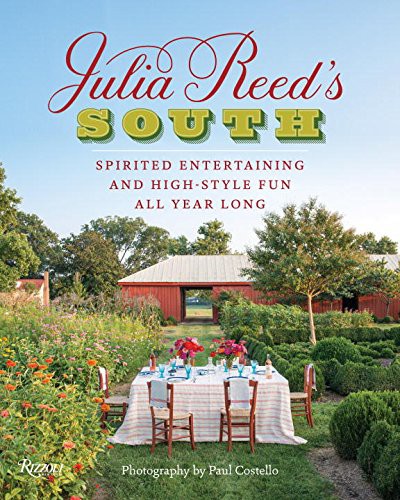
My Mother had a friend and she would say about her: "She always has champagne in the fridge, but she never has toilet paper." While my Mother saw this as a weakness, I was rather enamoured of this philosophy and it seemed all together Southern to me.
Here are some of the things we know about Southerners.
Give them a minuet or two and they can party for weeks. Kentucky Derby: about two minutes. Parties: two weeks. Mardi Gras: Fat Tuesday becomes Ash Wednesday at midnight. Parties: three weeks.
Southerners have loads of china and other forms of dishes. I personally have 4 sets of picnic dishes and I am not ashamed.
Baptists aside, a Southerner can mix up a fine cocktail with little more than a jar of grain alcohol and a peach from Chilton County.
As Julia Reed will tell you in her book, you can set the most elaborate table, order new napkins, have engraved invitations and still serve Popeye's... and that's what I like about the South.
Now Julia Reed's South is one of those books that is often classified as "aspirational" that is to say you probably can't call your favorite Pulitzer Prize winning author and get them to loan you their house for a party that involves a photo shoot for your cookbook like Reed can, but we know in your heart of hearts you want to.
So each "party opportunity" comes complete with exactly which china it was served on, who printed the invitations, where the napkins were bought, what vintage the wine was, and who lent the gorgeous property where the party was photographed. Frankly, we love that kind of info. In fact, many cookbooks go to enormous lengths to make you think that you have just stumbled on some grandly orchestrated tableaux, without filling in the details. We love the details.
The food is delightful and runs the gamut from tea sandwiches to a fine pulled pork. One of our favorite party items is a savory sorbet and Reed weighs in with variation of the Belle Meade Country Club tomato sorbet. Mac and cheese is elevated to Gratin de Macaroni. Chess pie becomes squares.
I do love this book because it follows in the tradition of one of my favorite cookbook authors of all time, Lee Bailey. Bailey would revel in the new found adoration of Southern food. Frankly, he should be adored even more. Reed writes:
"But the book that had the greatest impact was Lee Bailey's Country Weekends."Many years ago, my friend Harry Lowe and I were cooking. He had a recipe he wanted to try and he was reading it to me. "It sounds like Lee Bailey," I said. Harry Lowe looked and said it was indeed. You could just tell. Bailey had the ability to take high and low and mix it up into something wonderful. He would be very proud of Julia Reed.
This recipe is a take on a crab dip that one often sees at fancy soirees, but here it becomes a rather heavenly grilled cheese.
Grilled Deviled Crab & Cheese Sandwiches
4 tablespoons (½ stick) butter, plus more for grilling
1 cup finely diced andouille sausage
1 medium yellow onion, finely chopped (about 1 cup)
¼ cup thinly sliced scallions, including some of the green tops
¾ cup heavy cream
¼ cup grated Parmesan cheese
¾ cup grated good Cheddar cheese
1 teaspoon Tabasco sauce
1 ½ teaspoons Lea & Perrins Worcestershire sauce
1 large egg yolk
1 pound lump crabmeat, picked over for shells and patted dry
2 teaspoons fresh lemon juice
1 loaf Pepperidge Farm Very Thin Sliced White Bread
½ cup finely minced Italian parsley or chives, or a mixture of both
Melt the butter in a skillet over medium heat. Add the sausage and fry for 5 minutes. Drain off all but 1 tablespoon of the fat. Add the onion and sauté until soft, about 8 minutes. Add the scallions, cream, Parmesan, Cheddar, Tabasco, and Worcestershire sauce and still until the mixture is bubbling and thickened, about 8 minutes. Remove from the heat.
Beat the egg yolk in a large bowl. Gradually add about 1 cup of the cheese mixture, mix well, and stir in the rest. Toss the crab in the lemon juice and fold it into the filling. Taste for seasoning and refrigerate, covered with plastic wrap, for at least 1 hour before making the sandwiches. (At this point the filling may be refrigerated overnight.)
To make the sandwiches: Cut the crusts off the bread, spread a layer of crab filling between 2 slices, press them together, and repeat. In a large skillet, melt 1 tablespoon butter over medium heat. Place as many of the sandwiches in the skillet as it will hold. Press down lightly with a spatula and turn over after about 2 minutes, or as soon as the underside is golden brown. Press down again and remove the sandwiches to a warm baking sheet when the flipsides have browned. As you cook, you will likely need to add more butter. If the butter gets too brown after a few batches, you may need to wipe out the pan and start over.
When all the sandwiches are done, spread the minced parsley on a plate. Cut each sandwich in half into triangles and dip the long edges into the herbs. Serve immediately.
Feel free to serve them on your Grandmother's Haviland or on a My Little Pony paper plate! Julia won't mind.
21 June 2016
A Mouthful of Stars

Sunée took a look at all those various places that she had live in, traveled through, and eaten well. She dives into food in these areas and offers up a series of recipes featuring local foods presented in new and exciting ways. The book is a tour of the world, a travelogue in recipes that visits the places near and dear to the heart of Kim Sunée.
In surfing the web, we ran across this recipe. Nothing makes us happier than a good pots de crème. Since we gravitate toward the savory, this recipe hit the spot.
Cheese and Thyme Pots de Crème
¾ cup heavy cream
1 teaspoon black peppercorns, crushed
1 clove garlic, crushed
2 to 3 thyme sprigs
2 egg yolks
2½ ounces Comté or Parmigiano-Reggiano, finely grated
¼ cup hazelnuts or walnuts
Freshly ground black pepper
Toasted baguette slices and endive spears to serve
2. Heat the cream in a medium pot over medium-high heat to a very low boil. Add the peppercorns, garlic, and thyme sprigs. Turn off the heat and let steep for 15 minutes. Strain the cream through a fine-mesh sieve into a bowl.
3. Combine the egg yolks, infused cream and the cheese in a bowl and blend until well combined. Divide the mixture evenly between the ovenproof glass jars; it will probably fill the jars about three-quarters of the way. Bake for 25 minutes.
4. Lightly toast and chop the nuts. Sprinkle the nuts and pepper over the custards and bake for another 15 to 20 minutes. The custards should be slightly jiggly in the center but mostly set. Let rest for a few minutes before serving with toasted baguette slices and crisp endive spears.
Glad we found A Mouthful of Stars.
Subscribe to:
Posts (Atom)

