28 June 2016

In Good Taste

While we are on the topic of Southern parties...

This oldie but goodie is one of my favorites. In Good Taste: A Collection of Occasional Buffet Menus is a very stripped-down version of how to throw a party, without glossy photos.  The author, Joan Downs, writes the introduction to the book to her "Daughters" that would be you the reader.  (If you are a son, well, you can still use the cookbook.)  She signs her introduction, "Momma."  Momma says that a buffet, while signalling abundance, can be a small affair.  She wants you to break out your sideboard or your huntboard, whichever is available and serve up some food.  And while there are no photos, there are suggestions for wine and decor. 

There is als a bit of back and forth between Momma and her Daughters just in case you have a question or two.  There are bon voyage buffets, Superbowl buffets, Christmas buffets, and simple Sunday night suppers.  The cookbook has a ringed top and hard covers that allow the cookbook to stand on the counter. 

Remember we told you of the simple Sunday night supper.  Here is what you will be serving:

Drink

Bourbon Sours
Vodkatini

Starters

Sherried Mushrooms

From the Huntboard

Minestrone
Italian Filled Bread
Pepper, Olive, Beet, Red Onion Salad
  or Valdalia Onions, Baked
Baked Chantilly Potatoes
  or Souffle Potatoes

From the Dessert Board

Creamy Ices Chocolate Cake
  or Sabayon
  or Ice Cream Pecan Balls and Chocolate Sauce
  or Angel Food pie
  or Rhubarb Cake
Flaming Brandy Coffee

Wine Suggestion

Red Burgundy of Italian Borolino

Decoration

Wooden or pottery bowls filled with celery stalks, green peppers. fresh tomatoes and fresh basil.

Granted, it looks a bit longer than it actually is.  You need to pick a single dessert to go with the Flaming Brandy Coffee, but still...

In this menu we decided to opt for the Valdalia Onions.  And here is where we get to talk to Momma:

D. What's the difference between a Valdalia onion and a plain white onion?

M.  Valdalia onions are grown in Georgia.  They cost about 35 cents each. they are seasonal, usually through the month of June.  They are very sweet, and there are some who eat them raw like an apple. I prefer an hour at 325 myself!
We love the emphasis on "each."  We also noticed that they are spelled Vidalia, but Momma tried.  She would be shocked to go grocery shopping today!
Valdalia Onions, Baked a la Maude

Valdalia onions (one per person)
1/2 tsp. salt
2 tbs. brown sugar
1 tbs. butter or margarine

Skin onions. Cut a slice from the root end, so it will sit in a pan evenly.  Cut out a small hole from the top of the onin.  Place onions, side by side, in a buttered baking dish or pan.  Add water to the pan of 1/4 " depth.  Pour seasonings in hole. Bake at 325 degree F. oven until onions are done. (for about 1 hour.)

Just guess what the Christmas Buffet entails!  A quick google will point you to your own downloadable copy of In Good Taste.  Now clear off that huntboard and get to work.


23 June 2016

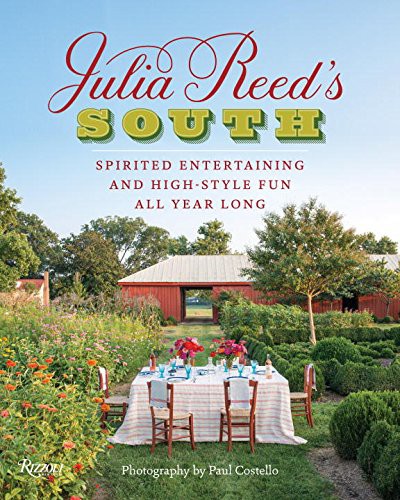
Julia Reed's South

I got Julia Reed's South as a birthday present (thank you Anne.) But it wasn't published till after my birthday, so it was one of those gifts that keeps on giving.  Julia Reed is great ol' broad, in the truest sense of the phrase.  The spirit of this greatness comes through in her book.

My Mother had a friend and she would say about her:  "She always has champagne in the fridge, but she never has toilet paper."  While my Mother saw this as a weakness, I was rather enamoured of this philosophy and it seemed all together Southern to me.

Here are some of the things we know about Southerners.

Give them a minuet or two and they can party for weeks.  Kentucky Derby: about two minutes.  Parties: two weeks.  Mardi Gras: Fat Tuesday becomes Ash Wednesday at midnight.  Parties: three weeks.

Southerners have loads of china and other forms of dishes.  I personally have 4 sets of picnic dishes and I am not ashamed.

Baptists aside, a Southerner can mix up a fine cocktail with little more than a jar of grain alcohol and a peach from Chilton County.

As Julia Reed will tell you in her book, you can set the most elaborate table, order new napkins, have engraved invitations and still serve Popeye's... and that's what I like about the South.

Now Julia Reed's South is one of those books that is often classified as "aspirational" that is to say you probably can't call your favorite Pulitzer Prize winning author and get them to loan you their house for a party that involves a photo shoot for your cookbook like Reed can, but we know in your heart of hearts you want to.

So each "party opportunity" comes complete with exactly which china it was served on, who printed the invitations, where the napkins were bought, what vintage the wine was, and who lent the gorgeous property where the party was photographed.  Frankly, we love that kind of info.  In fact, many cookbooks go to enormous lengths to make you think that you have just stumbled on some grandly orchestrated tableaux, without filling in the details.  We love the details.

The food is delightful and runs the gamut from tea sandwiches to a fine pulled pork.  One of our favorite party items is a savory sorbet and Reed weighs in with variation of the Belle Meade Country Club tomato sorbet.  Mac and cheese is elevated to Gratin de Macaroni.  Chess pie becomes squares. 

I do love this book because it follows in the tradition of one of my favorite cookbook authors of all time, Lee Bailey.  Bailey would revel in the new found adoration of Southern food. Frankly, he should be adored even more.  Reed writes:
"But the book that had the greatest impact was Lee Bailey's Country Weekends."
Many years ago, my friend Harry Lowe and I were cooking.  He had a recipe he wanted to try and he was reading it to me.  "It sounds like Lee Bailey," I said.  Harry Lowe looked and said it was indeed.  You could just tell.  Bailey had the ability to take high and low and mix it up into something wonderful.  He would be very proud of Julia Reed.
 
This recipe is a take on a crab dip that one often sees at fancy soirees, but here it becomes a rather heavenly grilled cheese. 

Grilled Deviled Crab & Cheese Sandwiches 

4 tablespoons (½ stick) butter, plus more for grilling
1 cup finely diced andouille sausage
1 medium yellow onion, finely chopped (about 1 cup)
¼ cup thinly sliced scallions, including some of the green tops
¾ cup heavy cream
¼ cup grated Parmesan cheese
¾ cup grated good Cheddar cheese
1 teaspoon Tabasco sauce
1 ½ teaspoons Lea & Perrins Worcestershire sauce
1 large egg yolk
1 pound lump crabmeat, picked over for shells and patted dry
2 teaspoons fresh lemon juice
1 loaf Pepperidge Farm Very Thin Sliced White Bread

½ cup finely minced Italian parsley or chives, or a mixture of both 

Melt the butter in a skillet over medium heat. Add the sausage and fry for 5 minutes. Drain off all but 1 tablespoon of the fat. Add the onion and sauté until soft, about 8 minutes. Add the scallions, cream, Parmesan, Cheddar, Tabasco, and Worcestershire sauce and still until the mixture is bubbling and thickened, about 8 minutes. Remove from the heat. 

Beat the egg yolk in a large bowl. Gradually add about 1 cup of the cheese mixture, mix well, and stir in the rest. Toss the crab in the lemon juice and fold it into the filling. Taste for seasoning and refrigerate, covered with plastic wrap, for at least 1 hour before making the sandwiches. (At this point the filling may be refrigerated overnight.) 

 To make the sandwiches: Cut the crusts off the bread, spread a layer of crab filling between 2 slices, press them together, and repeat. In a large skillet, melt 1 tablespoon butter over medium heat. Place as many of the sandwiches in the skillet as it will hold. Press down lightly with a spatula and turn over after about 2 minutes, or as soon as the underside is golden brown. Press down again and remove the sandwiches to a warm baking sheet when the flipsides have browned. As you cook, you will likely need to add more butter. If the butter gets too brown after a few batches, you may need to wipe out the pan and start over. 

When all the sandwiches are done, spread the minced parsley on a plate. Cut each sandwich in half into triangles and dip the long edges into the herbs. Serve immediately. 

Feel free to serve them on your Grandmother's Haviland or on a My Little Pony paper plate!  Julia won't mind.

21 June 2016

A Mouthful of Stars

Rarely does a cookbook fly under our radar.  Somehow, A Mouthful of Stars by Kim Sunée was one of those books. The good news is, we found it!  Sunée has lead an interesting life.  As a young child, she was adopted from Korea. She grew up in New Orleans.  She lived in Sweden, spent nearly a decade in France, she even owned a poetry bookstore!  Her memoir, Trail of Crumbs, was a best seller. 

Sunée took a look at all those various places that she had live in, traveled through, and eaten well. She dives into food in these areas and offers up a series of recipes featuring local foods presented in new and exciting ways. The book is a tour of the world, a travelogue in recipes that visits the places near and dear to the heart of Kim Sunée.

In surfing the web, we ran across this recipe. Nothing makes us happier than a good pots de crème. Since we gravitate toward the savory, this recipe hit the spot.


Cheese and Thyme Pots de Crème

¾ cup heavy cream
1 teaspoon black peppercorns, crushed
1 clove garlic, crushed
2 to 3 thyme sprigs
2 egg yolks
2½ ounces Comté or Parmigiano-Reggiano, finely grated
¼ cup hazelnuts or walnuts
Freshly ground black pepper
Toasted baguette slices and endive spears to serve

 
1. You’ll need 2 ovenproof glass jars, such as short widemouthed (4-ounce) Mason jars, or ramekins. Place the jars or ramekins on a baking sheet; set aside. Preheat the oven to 225 degrees. 
 
2. Heat the cream in a medium pot over medium-high heat to a very low boil. Add the peppercorns, garlic, and thyme sprigs. Turn off the heat and let steep for 15 minutes. Strain the cream through a fine-mesh sieve into a bowl.

3. Combine the egg yolks, infused cream and the cheese in a bowl and blend until well combined. Divide the mixture evenly between the ovenproof glass jars; it will probably fill the jars about three-quarters of the way. Bake for 25 minutes.

4. Lightly toast and chop the nuts. Sprinkle the nuts and pepper over the custards and bake for another 15 to 20 minutes. The custards should be slightly jiggly in the center but mostly set. Let rest for a few minutes before serving with toasted baguette slices and crisp endive spears.

Glad we found A Mouthful of Stars.

16 June 2016

Pride and Pudding

Brit's love to label any dessert a "pudding" but in reality British puddings started out being savory foods, before the word was used as a generic term.  A while back, a nice Flemish girl named Regula Ysewijn delved into the history of proper English puddings and wrote Pride and Pudding. We cannot tell you how happy we are that she did.

 We, too, are fond of proper English puddings.  We, too, collect ancient pudding tins and molds.  We, too, collect old cookbooks.  Really, nothing says loving like a good spotted dick. Seriously, this is one of those cookbooks you simply have to love. 

First, Ysewijn, gives credit to all those who have gone before.  Some Flemish girl didn't invent steamed pudding, but she sure knows a thing or two about them. She traces the history of pudding in English culture from A Book of Cookrye, published in 1584 right through to Heston Blumenthal. She shoots her own photos, and each image resembles a painting. She shows off her collection of pudding basins along with many cookbooks. There is a large bibliography tucked in the back.   It is a true embarrassment of riches. 

Again, simply ask yourself, when was the last time you found a really great blancmange recipe?  That calf's foot blancmange from Catharine Beecher get old real fast!

If you buy one cookbook this week (OK, "this month" is the best we can do) grab a copy of Pride and Pudding.  Before the book was published, one cold actually purchase a matching pudding bowl to accompany the book.  Now you know we want to order one, but shipping books to the US is hard enough without adding a ceramic bowl.  Still, we are really sorry we didn't get one.

Take a look at this recipe for rice pudding.  Ysewijn lists a series of cookbooks that offer up a "rice pudding" that made with a stock. Rice pudding as it known today is often a cloyingly sweet mass of rice sugar and milk.  Traditionally, a rice pudding was more like an Italian risotto.  Given the choice, we choose this recipe.

Rice Pudding 

120g short-grain rice, such as arborio
500ml beef broth
500ml almond milk
A few saffron strands

Put the rice and broth in a deep saucepan and heat gently. Stir well and bring to the boil. Simmer and stir often so the rice doesn’t stick to the bottom of the pan.
When the liquid is almost completely absorbed, after about 15 minutes, add the almond milk and saffron. Stir well, then simmer gently for 20-30 minutes, stirring every now and then until all the liquid is absorbed and the rice is cooked and thick. Spoon the cooked rice pudding into a serving dish. 


You can keep tabs on Ysewijn, AKA  Miss Foodwise here.

14 June 2016

Woodward & Lothrop Cook Book

Last week when I was sick, I was reading a lot of stuff on the web.  The problem with reading stuff on the web is the links.  One site leads you to another and that one leads you somewhere else. Three days later when you are thinking about something you read, it is hard to remember where exactly you read it.

I read about someone making a recipe from the Woodward & Lothrop Cook Book.  I went and pulled out my Woodies cookbook and started reading up on it.  Then I decided to write about it, but I wanted to give a shout out to the person who sent me looking more deeply at the cookbook.  So, I searched and luckily, the post I read was recent, and it didn't take long before it popped up.  It was in the pie blog Nothing in the House. One of the founders is Emily Hilliard a folklorist and writer who lives just down the road(about 2 hours) from me in Charleston, WV. So here is your SHOUT OUT.

Woodward & Lothrop was THE place to shop in D.C.   It was like a shopping mall in the middle of a city.  There were clothes, shoes, and bridal wear.  There was china, glassware, cooking equipment, and dining sets.  There were toys, food, cameras, art, and candy.  If you needed it, Woodies had it.

Woodward & Lothrop Cook Book was written by Mabel Claire. The subtitle of the cookbook reads: For the Busy Woman including a Complete Guide to Kitchen Management. The cookbook was published in 1932.  What is wonderful about this book is its marketing.  As I said before, if you needed it -- it was at Woodies.  That is, if you needed it in Washington, D.C.

But what if you lived in Chicago?  Well, do not fear.  If Carson's was the place that had everything you needed there was the Carson, Pirie Scott & Co's Cook Book For the Busy Woman including a Complete Guide to Kitchen Management.  In New York City there was the Macy's Cook Book For the Busy Woman including a Complete Guide to Kitchen Management as well as the Gimbels Cook Book For the Busy Woman including a Complete Guide to Kitchen Management. There was a copy for the May Company, The Emporium, Meier & Frank, Bamberger's and more.  I am not sure how many different copies of Mabel Claire's cookbook is out there under a different store title.  If you think of it, though, it was a great idea.  There are still tons of people out there who were born BEFORE Amazon. Writing a single cookbook and selling it to a dozen department stores across the country was brilliant.

One recipe that many Woodies customers remember is a cookie called the Woodies cookie or the English Drop cookie.  People remember it having raisins, butter, and brown sugar.  Knowing the history of this cookbook, I am not sure this is actually the recipe, but here is the closest thing in the Woodward & Lothrop Cook Book.  


Drop Spice Cookies

1/2 Cup Softened Butter
1 1/4 Cups Flour
1/2  Brown Sugar
2 Egg Yolks
2 Teaspoons Baking Powder
1/2 Teaspoon Cinnamon
1/2 Teaspoon Cloves
1/2 Cup Stoned Dates Cut in Pieces
Nut Meats

Mix the softened butter with the brown sugar. Beat in the egg yolks. Add the dry ingredients sifted together. Beat them in, a little at a time. Add the dates and a few nut meats. Drop in tablespoonfuls on a buttered cookie sheet. Bake in a moderate oven for 10 minutes (375 F.). Makes eighteen cookies.

 Finally, Mable Claire will tell you that one of the most important kitchen tools is a mirror:
Above my stove I have hung a mirror in a green and gold frame. It reflects all the jolly kitchen as well as the cook. A cook should consult a mirror often. For what use is a decorative kitchen without a decorative woman in it! At least a woman as decorative as is humanly possible!

Really Mabel?


07 June 2016

Princess Pamela's Soul Food Cookbook

In the late 1960's and early 1970's, Signet published a handful of cookbooks.  One of their authors was Princess Pamela. She ran a little restaurant in New York called Princess Pamela's Little Kitchen.  The menu featured many soul food specialties like collards, black-eyed peas, and ribs. The meal would cost you about $2.00.

In 1969, signet published Princess Pamela's Soul Food Cookbook, with recipes for many favorites. Pamela tells us:
To someone like myself, cooking is a very personal kind of thing. I still use a domestic stove in the back of my small place, and preparing things about the way you would at home for regular meals. So I never gave much thought to getting my cooking down on paper.
Luckily for us, she did get them down on paper. The recipes are faced on each page with a sassy quote, may relating to food. The recipes are simple, pared down instructions that one might get from a relative.  Remember, she never much thought about writing down her recipes.

One of our favorite recipes that she wrote down was a popular way to cook pork -- in milk. It was a "Sunday" dish.  In the quote on the facing page, Pamela wrote:

On Sundays when I was nine
there was always lots of Bible
    readin"
and milk-baked ham
and singin' to the good Lord
before the biscuits got cold.
Milk-Baked Ham

A 2"-thick slice of ham
1 tablespoon flour
2 heaping teaspoons dry mustard
2 tablespoons brown sugar
Sweet milk

Combine the flour, dry mustard, and brown sugar. Work the mixture into both sides of the ham. Place in a baking dish and cover completely with milk. Bake at 350 for about an hour, or until the ham is tender. When the ham is done, its surface should be browned and the milk almost entirely disappeared.

I always look forward to Sundays!

23 May 2016

Some Oyster Recipes


It seems that we start EVERY post by how much we like X Y or Z.  I know you have heard this exact phrase before with a different subject, but we do love little oyster books. Oysters are not everyone's cup of tea, so when a series of books has a volume featuring the oyster, the oyster book is often one of the hardest to find. And face it, there is nothing better than an oyster on the half-shell, so all the recipes in the world don't amount to a vast culinary exploration.  One of my favorite books is M. F. K. Fisher's  Consider the Oyster.  It is quite remarkable to me because there are numerous recipes for oyster stew.  Almost every recipe has exactly the same ingredients, and yet Fisher writes about them as if each one is unique.

Helen Evans Brown wrote a tiny book called Some Oyster Recipes.  The book was published by Ampersand Press in Pasadena, California. Ampersand Press published small editions of books that were more works of art than actual books.  Some Oyster Recipes is a scant 28 pages. Published in 1951, it was voted one of the 50 Books of the Year by the American Institute of Graphic Arts.

Helen Evans Brown was a noted food writer in the late 1940's and 50's. She was a leading proponent of West Coast and California cuisine until her untimely death in 1964. This appetizer is the height of elegance.

Oyster and Caviar Sandwich

This is for one of those festive moments when champagne is being served and you are in an expansive mood. Cut rounds of fresh bread, spread half with butter, half with caviar; dip small oysters in lemon juice, put in between tow slices (one of each), and press firmly together. The oyster should be smaller than the bread so that its existence is unexpected.  Serve these delectables very cold.

Ah, to be in an expansive mood!


10 May 2016

Pie!

We love a good pie.  Let's rephrase -- no we do love a good pie.  We REALLY love a savory pie. In the U.S., we primarily think of pie as a sweet confection, but in Britain and many other places, the word "pie" evokes a savory concoction.  We love a good savory pie.  We love finding a book that expands our notion of pie. 

We saw a photo of one of Genevieve Taylor's pies at 1000 Cookbooks and we were smitten.  So we tracked down her book, Pie!. Then we realized this wasn't the first time we had run across Taylor.  Egg-lovers that we are, we also have a copy of her book, A Good EggPie! is part of series by Absolute Press. In addition to Pie!, Taylor has published Soup!, Stew!, and Mince!.  The titles offer up an idea of  Taylor's food philosophy. 

Taylor uses simple, readily available ingredients to construct pies that as tasty as they are lovely. Don't be too alarmed at what may seem like longs lists of ingredients and instructions.  Yes, some of the pies seem a bit complicated, but don't despair.  Take a breath and remember there is a crust, there is a filling, and there is cooking. 

Start with the crust.  Taylor gives specific and cogent instruction on making the various crusts. Her fillings for her pies explode with flavors. Yes, for you sweet lovers, there is a fine apple pie, a lovely lemon meringue, and more than a few tarts.  The book really shines with its savory options.  The traditional steak is there along side an ox cheek, oyster, and stout.  There are hand pies like Cornish pasties, but there are also vegetable options like squash and cumin yogurt, and pear and walnut with gorgonzola.  The is pork, game, fish, chicken, lamb along with lots of vegetable options.

Pie! has a great mix of options that will make you a star in your kitchen.  Here is a favorite.  It has beef and rich sweet potatoes that are spiked with a spicy horseradish.  We followed it with Taylor's recipes for making the shortcrust pastry.  In her introduction to her book, Taylor offers up the option to go ahead and use a store bought pastry.  That is one of our favorite shortcuts, so go ahead and cheat a bit. But whatever you do, grab a copy of this book.

Roast Beef, Sweet Potato, and Horseradish Pie

For the pie
 
2 tbsp olive oil
2 large onions, chopped
2 sprigs of fresh rosemary, leaves picked and roughly chopped
600g sweet potatoes, peeled and cut into 2cm chunks
300ml beef stock
300g cold roast beef, cut into bite-size pieces
2–3 tbsp grated horseradish (available in jars), or horseradish sauce for a milder flavour 
plain flour, for dusting
1 batch of Shortcrust Pastry (see page below for the pastry recipe)
salt and freshly ground black pepper

For the crumble topping
 
100g plain flour
50g butter, chilled and cut into little cubes
75g mature Cheddar cheese, grated 

To make the pie, put the oil into a large frying pan and set over a medium heat. Once the oil is hot, add the onions, along with the rosemary, and fry for 15–20 minutes or until lightly caramelised, stirring from time to time. Stir through the sweet potatoes and then pour in the stock, seasoning well with salt and freshly ground black pepper. Bring to the boil, then cover with a piece of damp greaseproof paper pressed down over the sweet potatoes, tucking it under snugly at the edges – this creates a steamy lid to help cook the sweet potatoes. Simmer until soft – this will take around 15 minutes, depending on the size of the chunks. 

Remove and discard the paper – the sweet potatoes should have absorbed most of the stock; if it is still quite liquid, then simmer, uncovered, for a few minutes. Remove from the heat, stir through the beef and horseradish and set aside to cool completely.

Once the filling is cold, preheat the oven to 200°C/180°C fan/gas 6.

On a lightly floured work surface, roll out the pastry to a thickness of about 4mm (the pastry needs to be slightly thicker here as the filling is robust so it needs a sturdy crust to hold it in) and use it to line a 23cm springform cake tin, bringing it about 4cm up the sides of the tin. Spoon in the filling, levelling it out as you go.

For the crumble topping, lightly rub the flour and butter together in a mixing bowl. When the mixture resembles breadcrumbs, mix through the cheese and season well with salt and black pepper. Sprinkle the crumble mixture evenly over the pie filling, but don’t pat or press it down as you want to leave it light and airy. 

Bake in the oven for 40–45 minutes or until the pastry is cooked through and the crumble topping is crisp and golden. Remove from the oven, leave to cool for a few minutes, then slide a knife around the inside of the tin and release the springform. Carefully transfer the pie to a serving plate or wooden board and serve hot. Green vegetables on the side are a great accompaniment for this pie, and perhaps a little extra horseradish sauce for those who like things fiery.


Shortcrust pastry recipe
 
Makes about 325g
Takes 10 minutes to make (plus chilling)

180g plain white flour
a pinch of fine salt
90g cold butter, cut into small cubes
3–4 tbsp ice-cold water 

Food Processor Method
Put the flour and salt into the food processor and whizz briefly together to mix, then add the butter cubes and pulse briefly a dozen times or so until you have coarse crumbs. If you use the pulse function in very short, sharp bursts (rather than just leave it in the ‘on’ position) to rub the fat and flour together, then I think it works more like super fast fingers and there is less chance of overdoing it. Next, you trickle in the ice-cold water, whilst pulsing all the while, just until the mixture resembles rough lumps and looks a bit like overcooked and dry scrambled eggs. Add only as much water as you need. Don’t keep processing until the mixture comes together in a big ball as that will develop the gluten in the flour too much, so be sure to stop before you get to that stage. 

Tip the clumped crumbs onto a sheet of cling film and gently squeeze together into a ball without pressing too hard – little air gaps are a good thing and will add a lightness and crumbliness to the cooked shortcrust. Wrap and chill in the fridge for at least 30 minutes before rolling out.

Traditional Rubbing-in (by hand) Method
The method is essentially the same, but your fingertips and thumbs work together to literally rub the flour, salt and butter together until you have coarse crumbs. Lifting your hands out of the bowl as you rub adds air. Then once again, add just enough cold water to bring the mixture together into clumps – I find a blunt table knife is best to use here, using it to stir and cut through the crumbed mixture as you mix. Again, tip the clumped crumbs onto a sheet of cling film and squeeze gently into a ball, then wrap and chill in the fridge for at least 30 minutes before rolling out. 


20 April 2016

Home Cooked


As Sara Morrow said in Modern Farmer, "Leave it to a woman to revolutionize cattle ranching."  The woman she was writing about is Anya Fernald.  Fernald has been roaming about the food world for many years from traveling around Europe offering help at dairy farms, to working in Italy with Carlo Petrini and Slow Food, to bringing Slow Food to America, to being a judge on Iron Chef, to running a cattle ranch.  I'm already tired!

As CEO of Belcampo, Fernald set out to develop a source for pasture-raised organic meat. There was a farm, then a slaughterhouse, then a butcher shop and restaurant, then multiple locations -- even a resort in Belize, and now, a cookbook.

Home Cooked is just that, home cooked recipes without fuss and flourish. What the recipes do posses is bold flavor that comes from fresh ingredients and a firm lack of fear in using everything her animals have to offer.  There are no foams or tweezers in Fernald's kitchen, there is fire and flame; braises and confits; beef and vegetables covered in sauces and soaked in wine.  It seems that on any given day, a party is just around the corner!

I know one can't, as they so often say, judge a book by its cover, but I love giant, nested bowls, and have some of the same bowls on my shelves, not to mention a beaten up wood table. Also, my favorite recipe in the book is one of my fave recipes. As a child, I never had to eat anything I didn't want to eat, but I had to try everything. It made me an adventurous eater from the start. You might think that whole animal cooking and braised veggies with garlicky sauces might not be something your family wouldn't eat, think again.

Fernald has small children and (aside from being one of my favorite foods) this recipe is her daughter's favorite. I like my chicken hearts skewered on stalks of rosemary, but brown butter has a certain appeal.  Fernald warns that the hearts should never be cooked beyond medium-rare. So remember, brown on the outside, pink in the middle.

Chicken Hearts Cooked in Brown Butter

2 tablespoons unsalted butter 
1 1/2 cups chicken hearts 
Flaky salt, such as Maldon, for serving

In a small cast-iron skillet over medium-high heat, melt the butter. When the milk solids are beginning to brown and the butter has a rich, nutty smell, add the chicken hearts and cook, tossing them around in the pan as if you’re making popcorn, until browned on all sides, no more than 2 minutes. Remove from the pan with a slotted spoon, sprinkle with flaky salt, and serve immediately. 
 
Hey, organic meats, big bowls, chicken hearts, we so want to party with this girl. You will, too.

06 April 2016

The Yellow Table

When Anna Watson Carl was growing up, she ate dinner with her family on a big, yellow table. There was nothing particularly interesting about the table, except for the fact that it was yellow.  When Carl graduated from college, her mother gave her the yellow table. While it might not seem like such a great present, the family totem proved to be just the right inspiration. Carl began throwing dinner parties at the table. Over the years, she immersed herself in her passion, food. She wrote, edited, and took off for France, then she uprooted for New York. The economy ebbed and flowed and finally, after much consideration, the yellow table came to New York.

A short time later, the yellow table became The Yellow Table, a blog. While writing the blog, she dreamed of a cookbook and faced those daunting "cookbook questions."  Do you own a restaurant? Do 100,000 people visit your blog -- every day? Do you have a television show?  If you answered no to the preceding questions, well then, you are not going to get a book deal.

Now most folks would be daunted, well, even crushed by this prospect, but Carl, who had spent time writing, editing other people's cookbooks, and setting up photo shoots decided she could do it herself.  She began the process by offering up daily updates on her blog, she logged onto Kickstarter, and took The Yellow Table on the road...not the actual table, but, you know.

Before long, the yellow table that she colored on as a child was transformed into The Yellow Table: A Celebration of Everyday Gatherings. The book is filled with seasonal, easy recipes that you can serve on a table of any color.  "This is my go-to lunch,' says Carl, 'I call it a detox salad, because it’s packed with nutrient-rich vegetables and has protein from the quinoa. To save time, I stop by the Whole Foods salad bar and stock up on shredded carrots, red cabbage, and cooked quinoa. Feel free to toss in some roast chicken if you want a heartier meal."

Detox Kale Salad
4 packed cups chopped kale (curly, Lacinto, red, or a combination), stems removed
1 cup shredded carrots (from about 2 medium carrots)
1 cup shredded red cabbage (from about 1/8 head cabbage)
3/4 cup cooked quinoa, cooled
1 avocado, peeled, pitted, and cubed
2 tablespoons freshly squeezed lemon juice (1 lemon)
1/4 cup extra-virgin olive oil
Fine sea salt and freshly ground black pepper

In a large bowl, toss together the kale, carrots, cabbage, quinoa, and avocado.

Pour the lemon juice into a small bowl. Add the olive oil in a slow, steady stream, whisking constantly Season to taste with salt and pepper. Drizzle over the salad and toss to combine. Taste and add additional salt and pepper, or another splash of lemon if you like. Serve immediately.

Store the salad, in an airtight container in the refrigerator, up to 1 day.

This week, The Yellow Table blog got a fresh, new design. Head over and take a look.


Blog Widget by LinkWithin