Showing posts sorted by date for query fine preserving. Sort by relevance Show all posts

14 April 2014

Pick A Pickle


You know we love us some preserving books.  We foresee a day when we will have more books ABOUT canning that we will have food that we have canned.  Fine! We exaggerate, but you know what we mean. 

People have been pickling vegetables since the invention of a salt and vinegar.  Grab some veggies, pour a hot brine of vinegar over them -- pickles.  It is not really brain surgery, but way more fun, and if you screw up, no one dies or ends up in a vegetative state.  But it is hard to screw up. 

So why another book?  Well, Pick A Pickle is one of those cookbooks that is not merely a cookbook but a kind of art. It is designed like a Pantone swatchbook. The recipes fan out of their carrying case to reveal a wide variety of recipes.  You have seen designers huddled over their swatchbooks finding just the right color, well we like to think of cooks sitting around pouring over exactly which pickle they will be making. 

Those cooks are in good hands as the chef behind Pick A Pickle is Hugh Acheson, who wrote one of our fave cookbooks of 2011 (and still), A Turn In The South.  Yes, there are recipes in the book that you have seen a billion times: Pickled Jalapeños, Pickled Okra, Pickled Watermelon Rind, and Pickled Beets and so on. But the true test of a good pickle book is this:  Does the author pickle something you never thought of pickling before?  So, alongside those old familiars, Acheson gives us his usual unusual turn in the South.

Are you one of those cooks who cuts out the nice bits of veggies and tosses the rest into the compost?  You will never do that again after this recipe


Pickled Turnip Stems

4 cups small turnip stems
2 garlic cloves
1 sprig fresh thyme
3⁄4 tablespoon pickling salt
1 tablespoon white granulated sugar
1 tablespoon mustard seeds
3⁄4 cup cider vinegar
3⁄4 cup water

Cut the turnip stems into 1⁄4-inch lengths. Pack the stems, garlic, and thyme into the jars, leaving 1⁄2 inch of headspace at the top, and set aside.

Combine the salt, sugar, mustard seeds, vinegar, and water in a nonreactive saucepan and bring to a boil. Reduce the heat to low and simmer for 5 minutes.

Carefully ladle the hot pickling liquid into the jars, leaving 1⁄2 inch of headspace in each. Cap with lids and bands, cool for 2 hours, and then either refrigerate or process according to the jar manufacturer’s directions.

The pickles can be refrigerated for 7 to 10 days; if processed, they will keep for up to 10 months.

Yes, Pick A Pickle it is a Hugh Acheson book, but we would like to give a big shout out to Rinne Allen who photographed it and Danielle Deschenes who designed this culinary swatchbook.  Now get out there and get yourself in a pickle.

26 March 2014

Preserving by the Pint

 Marisa McClellan's blog, Food In Jars has spawned its second cookbook, Preserving by the Pint.  If you read McClellan's blog, you know she cans in a very small kitchen.  She is great at taking a handful of ingredients and turning them into a couple of jars of jam.  When introducing this book she wrote:

All the recipes start with either a pint, a quart, or a pound (or two) because those are the units of measure that so many of us end up with after a trip to the green market, grocery store, or farm share pick-up.

We often lament the fact that we are not endowed with friends who have Meyer lemon trees in the back yard, or fig trees, or gigantic tomato patches.  We are often in the produce section facing 3 quince, a pound of Meyer lemons, or 6 blood oranges.  Most folks don't look at these tiny bounties and think -- marmalade!  Well you should.  Preserving by the Pint will be just the inspiration you will need.

We are notorious for buying EVERY canning, confiture, preserving book out there.  Yes, the repetition is astounding.  So picking up Preserving by the Pint was truly a joy as there are many recipes that seem familiar, but offer up a unique twist -- other than being calibrated to cook up a pint!

For years, when I thought of pickles, I would see my great-aunts with gigantic quart-sized jars, laboring away.  Frankly, I always thought buying them at the store was easier.  Then I realized one didn't have to "put up" forty quarts to get pickles.  But just try to find a recipe that makes one quart.  Well now you have a place to turn.  I was also weighted down by the notion that pickles had to be processed, yet hardly a meal went by that we didn't have some sort of refrigerator pickle that was made the night before.

Here is a a fine recipe for a quart of sugar snap peas.  You may find a really lovely mess of these peas at the store and think, "How could I use these?"  Well make these pickles. 


Marinated Sugar Snap Peas with Ginger and Mint

Makes 1 (1 quart/1 liter) jar

11⁄2 cups/360 ml unseasoned rice vinegar
1 tablespoon honey
1 teaspoon finely milled sea salt
1 pound/460 g sugar snap peas
1 green onion
1 sprig fresh mint
3 thin slices fresh ginger

In a small saucepan, combine the vinegar, honey, and salt. Heat until the honey and
salt are entirely dissolved.

Wash the sugar snap peas well. Using a knife, trim both ends and remove the
tough string that runs along the back of the peas. Cut the green onion into 2 or 3 segments,
so that they fit the jar. Stand them up in a clean 1-quart/1-liter jar, along with
the mint sprig and the ginger slices.

Pack the prepared sugar snaps into the jar. If they don’t all fit, set them aside. You
may be able to sneak them in once the pickling liquid is poured.

Pour the hot vinegar mixture over the sugar snaps. Tap the jar gently on the counter
to remove any air bubbles. If you had any remaining peas, try to pack them into the jar
at this time.

Place a lid on the jar and let the jar rest until it has cooled to room temperature.
Refrigerate. Let these pickles sit in the vinegar for at least 24 hours before eating.
They will keep for up to a week in the refrigerator.

Note: Make sure to use the freshest sugar snap peas you can find. No pickling
brine can restore crunch to a pea that’s lost it to age. If you can’t find sugar snaps,
this recipe works equally well with crisp snow peas.

You know you have a saucepan, a jar, and a refrigerator.  Go forth and preserve!

17 February 2014

Pitt Cue Co.


OK, we saw this book quite a lot.  It seemed to be quite popular.  But in the end we let prejudice get in the way.  After all, what could Brits possible know about barbecue?  What a joke, right?  Then our fellow bloggers led us down the cookbook path.  We willing admit, it is not hard to lead us down that path.  Then one of our favorite bloggers, Matthew Rowley of Rowley's Whiskey Forge wrote about this book, Pitt Cue Co.

Rowley was in Britain and browsing in a bookstore when someone articulated my very prejudice, Why would you want to buy a barbecue book in Britain?  Well, Rowley says the authors, Tom Adams, Jamie Berger, Simon Anderson and Richard Turner, understand the credo of cue -- low and slow.  What makes the book interesting is their use of local ingredients.

Fine, but this what captured my attention:

Pickled Hot Dogs.  This was a first for me in a barbecue book, in fact, it was the first in a preserving book.  You had me at pickled hot dogs.... The other big plus, they never shy away from adding booze to anything.  They are very nose-to-tail.   They feature one of my favorite sides, hominy and cheese.  They put chicken skin on their deviled eggs.  They make barbecue sauce into jelly.  These guys are great.

The drawback to the book is that often lamented problem of the restaurateur as cookbook author.   When one is used to cooking in a big, fully equipped kitchen, with minions to run errands and cook for you, it is often a bit hard to translate that experience in a way that the home cook can accomplish it without ordering from said restaurant.

But did we mention they pickle hot dogs?

Our Pickle Brine

water                                   1.5 liters
cider vinegar                       1 liter
caster or demerara sugar    700g
sea salt                                30g
optional aromats (peppercorns, bay leaves,
fennel seeds, coriander seeds, mustard seeds,
star anise, cardamom pods, root liquorice)

Put all the ingredients into a large pan and bring to a boil, stirring occasionally until the sugar and salt are dissolved.


Pickled Hot Dogs

Our Pickle Brine              1 liter
hot dogs                           1kg
chillies                              3
garlic cloves                     4
sprigs of thyme                3

Put the pickle brine into a pan and bring to a boil.

Stack the hot dogs neatly in 2 large sterilized glass jars with the chillies, garlic and thyme spread evenly throughout the jars.

Pour over hot pickling liquid and seal the jars.  Leave to cool, then refrigerate for 1 week before eating.


 Did we mention they pickle hot dogs?  We sincerely apologize that we dismissed this book based on the nationality of the writers.  It is now our very favorite book on cue!
The authors of the book — restaurateurs Tom Adams, Jamie Berger, Simon Anderson and Richard Turner - See more at: http://matthew-rowley.blogspot.com/2013/11/bookshelf-pitt-cue-co-cookbook.html#sthash.geohmKEa.dpuf
restaurateurs Tom Adams, Jamie Berger, Simon Anderson and Richard Turner — - See more at: http://matthew-rowley.blogspot.com/2013/11/bookshelf-pitt-cue-co-cookbook.html#sthash.geohmKEa.dpuf
restaurateurs Tom Adams, Jamie Berger, Simon Anderson and Richard Turner - See more at: http://matthew-rowley.blogspot.com/2013/11/bookshelf-pitt-cue-co-cookbook.html#sthash.geohmKEa.dpuf

13 December 2013

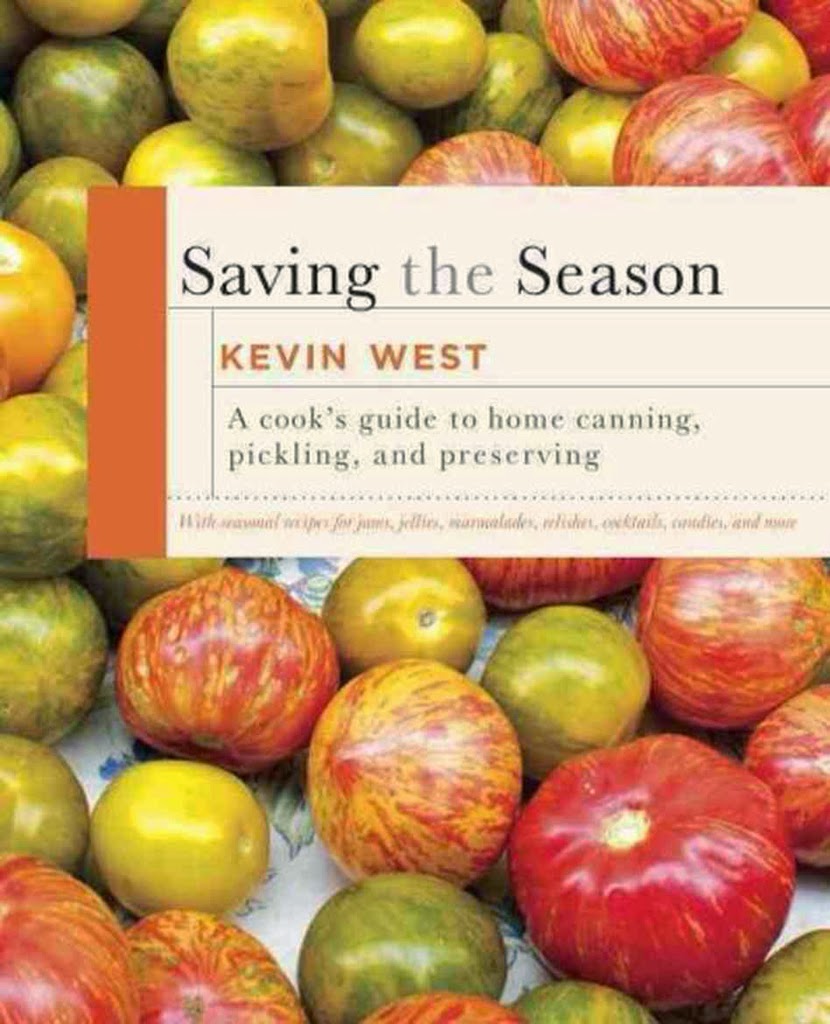
Saving the Season


if there is a preserving book we want it. Like our profound love of French cookbooks, we also covet every preserving book. By now, if you can cook it syrup or douse it in a brine, we have stuffed into canning jars. While most canning books are fine, fun, and full of info, few are comprehensive guides to putting up food. Saving the Season by Kevin West is that comprehensive book.

West grew up in the South and watched his grandmother make jam. Living in California for years, West, was a writer and pretty fine cook. On day he impulsively bought a flat of strawberries and realized that he and his friends could never use them all before they rotted. Holding those strawberries pulled him back to his past, like a powerful sense memory. When he thought of all those years he watched his grandmother make jam, he came to the stark realization that he never really knew how she made the jam. Trying to recreate that flavor, he found recipe after recipe of strawberries covered in sugar, pectin, and boiled. West's reporter side kicked in.


He started studying and cooking and cooking and finally blogging. His blog, Saving the Season turned into an opus of the same name. Yes, Saving the Season will explain how to make jam, jelly and pickles, but it does much more. You will also find:


Lovely photographs

Recipes for using your canning products

Master canners

Food writers

Fiction writers

Poets

Artists

Road trips

An extensive bibliography

An appendix of fruit varieties

An appendix of peak fruit by months


If you have never touched a Ball jar, there is something in this book for you. Ever walked into the kitchen after your friends offer to make margaritias. The drinks were great but there is a huge pile of squeezed lime halves. (you know some of them were not squeezed that well as the drinks went on, so there is a lime juice pooling up.) This is a great recipe to make use of those limes. you don't have to make it right now. Stuff the lime carcasses in a Ziploc bag and wait till the buzz is over.


Limeade Syrup

1/2 pound of lime rinds

2 1/2 cups of water

3 cups sugar

10 coriander seeds

2 cloves

2 allspice berries

Two 1/4-inch slices fresh ginger root

Optional: 1 Kaffir lime leaf and 2 inches lemongrass stalk, crushed

Combine all the ingredients in a saucepan, and simmer for 30 minutes. Strain through a fine-mesh sieve. Store in a sealed bottle in the refrigerator for up to 6 months


We were thrilled to see that Saving the Season was one of Amazon's Best Cookbooks of 2013. It was clearly one of ours.


06 December 2013

The Little Book of Home Preserving

Preserving books are another of our weaknesses. Really, if you know how to make jam, you really don't need a cookbook. If you don't know how to make jam the vast number of books explaining how to make jam can be daunting. What's a cook to do?


Here's an idea. Grab a copy of The Little Book of Home Preserving by Rebecca Gagnon. It has everything one needs to know about canning a some interesting spins for those of you who can every week. It is the best of both worlds. Yes, it is a little book, but don't let its size fool you. Just because you can slip it into your pocket, might just be a good thing. Ever gone away for the summer and needed to find a reicpe? This book is perfect to toss into your hamper and take on the road.


The recipes are fresh; familiar with a zippy spin. Try the Kumquat-Habanero Marmelade. How about Jicama Apple Cumin Kraut? Or the Citrus Chai Ground Cherry Preserves. She calmly explains that preserving is not always a precise endeavor and she wallks the reader through the vexing variations that occur while canning.

We just love a good shrub, and this one will definitely be on our list.

Elderberry Drinking Vinegar

2 pounds ripe elderberries

1 quart raw apple cider vinegar (such as Braggs)

4 to 6 cups granulated sugar

1. Separate the tiny elderberries from their stems. (An easy way to do this is to place them in the freezer for a half hour and then comb through them with a sterilized, wide-toothed comb.)

2. Place the elderberries in a large glass bowl, crush them gently with a masher, and cover them with the vinegar. Cover tightly with plastic wrap, and store somewhere at room temperature out of direct sunlight for 1 week.

3. Strain the vinegar out of the elderberries into a large bowl, using a fine mesh sieve. Press gently on the berries to help them release all of their remaining juices. The vinegar will be a beautiful purple color.

4. Measure the vinegar and pour into a preserving pot. For every 1 cup of vinegar, add 3/4 to 1 cup of granulated sugar. Over very low heat, stir the vinegar until the sugar melts. (Keeping the vinegar well below the boiling point helps it to remain "raw" and healthful.) Once the sugar is fully dissolved, turn off the heat and remove the pot.

5. Sterilize the jars.

6. Let the drinking vinegar cool completely before storing in sterilized airtight glass bottles or canning jars at room temperature, where it will remain good for one year. To enjoy, pour 2 tablespoons in the bottom of a glass, and top with seltzer or still water.


If you are looking for a niftly stocking stuffer this Christmas,The Little Book of Home Preserving is just the ticket. You can read more from Rebecca Gagnon at her popular blog, CakeWalk.


14 March 2009

Putting Up


My friend Ann (not to be confused with my friend AnnE, who often comments on the blog and tries to correct my dyslexic spelling) gave me two very different cookbooks. I have been craving Putting Up: A Seasonal Guide to Canning in the Southern Tradition by Stephen Dowdney. It is a cookbook on preserving from a Southern perspective written by a guy who ran his own boutique canning company and was a classmate of Pat Conroy at The Citadel. Good enough for me.

Not good enough for the people who comment on Amazon. This book has been savaged on Amazon --IGNORE THEM!!! Mr. Dowdney offers and alternative to traditional hot water baths for sweetly acidic jams, etc. He tells his reader how to use the inversion method. One would think he had written a book advocating canning kittens and puppies! I recently put up some blackberry preserves and put them up at Lucindaville.

In that post I sort of addressed this controversy. I, like Mr. Dowdney, Christine Ferber, Clotilde Dusoulier, June Taylor and many other illustrious cooks, use inversion to seal my sweet jams. The British and French have done it this way for years. I understand your concern. That is why I am so surprised about the negative comments for Putting Up. This is one of the first books on preserving (and I have many, from at least 4 continents) that explains how the home cook can ph test canning to make sure it is safe. I have always wanted to preserve garlic, but I have read that it is a harbinger of bacteria and I have shied away from canning garlic. After reading this book, I am looking forward to the garlic crop coming in, as it is my first canning recipe from this book!!

For you, I have chosen a favorite of mine, ginger pear preserves. To avoid any controversy, I am going to give you the recipe. You can use it as you see fit.

Ginger Pear Preserves

INGREDIENTS
3 pounds pears, firm but ripe, peeled, seeded and chopped
2 pounds sugar
2 lemons, sliced thin, seeded and slices quartered
2 tablespoons lemon juice
2 ounces crystallized ginger, chopped fine

Pace pears and sugar in a pot; simmer, stirring often. While pears are softening, add lemon slices, lemon juice and ginger. Increase heat and cook until syrup thickens.


Break out those biscuits!

26 January 2009

Fine Preserving

Today's cookbook is a twofer, two different editions of Fine Preserving by Catherine Plagemann. In the late 60’s Plagemann’s slim book on preserving featured both sweet and savory recipes for chutneys, sauces, jellies and condiments. Today’s more adventurous audience would probably embrace Plagemann’s book, but it went out of print not long after it was published.

The book might have fallen into obscurity, but it had a great champion, M. F. K. Fisher. Though they never met, Fisher was instrumental in getting the book re-issued but with a twist.

While sitting around talking about books with a group of people, including small publisher, John Harris, the subject of lost classics came up. Fisher stated that the one book she would have reprinted was Fine Preserving. Intrigued by that choice, John Harris said he would look at a copy but several days later he called Fisher to say he could not find one in any library. (It was the olden days before Amazon.) Fisher offered to send him her copy, but when he received it, he found the pages annotated with personal notes. Instead of simply re-publishing the book, Harris wanted to publish it with M.F. K. Fisher’s annotations. Mrs. Plagemann died several years before the annotated version, so she never knew of the great influence the book had on Fisher.

The second incarnation of Fine Preserving, nearly 20 years after the first combines the original with cryptic and biting marginalia from Fisher.


This is one of Fisher’s favorite recipes and one of mine, too.

Pickled Seedless Grapes

Wash and stem enough grapes to make 3 cups. Place them in 3 very clean half-pint canning jars.
Combine:
1 1/2 cups granulated sugar
1 cup white wine vinegar or white vinegar
3 3-inch cinnamon sticks
1 tablespoon minced onions
Bring these ingredients to a boil, stirring well to distribute the sugar; simmer mixture for five minutes. Pour the syrup over the grape, putting 1 cinnamon stick in each jar. Stir and let stand overnight. Next day the grapes will be ready to serve.
If you want to keep the relish for future use, it is a good idea to put the jars in brown-paper bags before putting them on the shelf, as the light tends to darken the top layer of grapes, and this is not a pretty site. Plan to use this pickle soon, or at least before the year is out, as the grape skins toughen as well as darken if they are kept too long.
Serve this relish with meat, fish, poultry or game.
It also makes a delicious and unusual condiment as an accompaniment to curry.


M.F. K Fisher’s Commentary

And so now we come to one of my favorite recipes in the whole book! (There are two of them. The other is for Chermoula.) I make these pickled grapes very often, Winter and Summer, now that in California we can get good seedless grapes fro South America to add to our own crops. People are astonished and pleased by them.
The pickle should be served cold, drained of juices, and without the cinnamon stick. My version is somewhat different from Mrs. Plagemann’s: I’ve cut out the minced onions. I don’t think it adds anything. (Perhaps cherries, pitted or not, might be good this way?)
Mrs. Plagemann uses little jars filled with grapes, washed and dried, and with one cinnamon stick in each jar. The hot syrup (really a kind of bar-mix, called “simple syrup,” I think) is poured in immediately and they are sealed.
The cinnamon stick I find essential. I tried once without it and it didn’t “feel” right. White seedless grapes will turn brown, as she says, so they should be put in a dark place. Myself, I think the seedless “flame” grapes, the red Peruvians, are the most delicious. They last a couple of years, but I feel that after one month they are at their best, rather crisp and fresh tasting. (But they are fine in one day!) They are delicious with any sandwiches, or cold meats, or fowl hot or cold, fish hot or cold, veal smoked or not, lamb…all most anything except maybe vanilla ice cream.


I agree with Fisher, the onions are not necessary, but I think they would be quite lovely heated and poured over vanilla ice cream! These grapes are a perfect hostess gift. Face it, everyone brings a bottle of wine, so why not mix it up a bit with these lovely pickled grapes.

09 January 2009

Sensational Preserves


I don’t care if you ever make single recipe in this book, the pictures alone make Sensational Preserves by Hilaire Walden worth owning. Sensational is a good word to describe the photography in this book, which has over 125 photos. The preserves look like they were created in a home kitchen. Ok, a home kitchen with a talented cook – with copious time on her hands, but still…


A fundamental difference exists between preserving in Europe and in the U.S. Americans process preserves in a water bath. Europeans add hot preserves to hot jars, invert the jars, then right them after a few minutes. For all of you who dutifully read their 4-H canning instructions, this inversion method is unacceptable. While Walden is British, in this book, she advocates a water bath process with most recipes. The copy I own is the American version and it would be interested to see if the original British version uses the water bath or if that method was added to the American version.

This kumquat recipe is one of the few that requires no processing.

Kumquats in Vodka and Cointreau

3/4 plus 2 tablespoons sugar
2 1/2 pounds kumquats
1 1/4 cups vodka
2/3 cup Cointreau

Mix the sugar and 2 1/2 cups of water in a large pan and heat gently, stirring, until the sugar dissolves. Meanwhile, prick the kumquats all over with a large embroidery needle. Add them to the pan and simmer for about 15 minutes or until the skin feels soft; pierce with a fine skewer to test.

Using a slotted spoon, remove the kumquats from the syrup and pack into warm, clean, dry jars. Pour the vodka and Cointreau over the kumquats, then fill to the top with the reserved syrup.

Cover and seal the jars. Invert them gently to mix the liquids. Store in a cool, dark, dry place for a least one month before eating.


These kumquats are lovely simply served over ice cream. I also like to open a jar and scatter them around a roasting chicken during the last half hour of cooking.
Blog Widget by LinkWithin