13 January 2014

Southern Living Little Jars, Big Flavors


This weekend I got an e-mail from a friend who was in a proper hardware store.  She said she found 1/2 gallon Ball jars and commented that she hadn't seen jars that size in a long time.

Indeed, if there is a canning "trend" out there in the air it is for small jar canning.  Rarely these days does anyone can much more than a pint?  I recently bought some jars that were 9 ounces and when I got them, I thought they were too big for most things.  If you grew up in the South, you are probably familiar with long shelves of canned good that your grandma "put up."   Today smaller is better.  Grandma still has long shelves of jams and pickles; they are just smaller and easier for you to take home!

After all these years of chronicling Southern living, Southern Living has published its first book of preserves.  Southern Living Little Jars, Big Flavors enlisted non other than Virginia Willis to write for this book.   Now as often happens with this blog, we were sure, SURE we had written about Virginia Willis' book, Bon Appétit, Y’all.  Well, evidently, we were remiss.   How did we not write about a Southern, French book?  We sincerely apologize for this and will make amends soon.

We do, indeed, love our canning books. There have been tons of them published recently, from the very basic to the overly complicated.  Like many Southern Living cookbooks, this one is grounded in the basics.  If you want summer's berries in a jam next spring, this book will show you how.   But what if you just want to make some jam for a Valentine's breakfast?  This book will also give you a range of refrigerator recipes, that a quick and require a minimum of equipment.

In Alabama, we always had jars of pickled vegetables in the refrigerator.  I never thought much about how they got there, nor about how easy they must have been to produce, since I never remember any grand process for making them.  When I saw Virginia Willis' recipe for Confetti Pickles, I remembered how wonderful those crisp, tangy vegetables were as a compliment to dinner, and how simple they were to make.   They are the essence of little jars with big flavors.


Quick Confetti Pickles

1 English cucumber
1 medium-size yellow squash
4 Tbsp. canning-and-pickling salt, divided
1 long, slender medium carrot
2 pink, purple, or red icicle radishes or 10 standard-size radishes
4 dill sprigs
1 cup cider vinegar (5% acidity)
¼ cup sugar
2 Tbsp. lemon juice
1 tsp. dill seeds

1. Wash vegetables. Score cucumber and squash lengthwise with a fork, leaving furrows in the peel on all sides. (This makes scalloped edges when vegetables are sliced.) Trim stem and blossom ends of cucumber and squash; cut into 1⁄8-inch slices. Place in a colander in sink; sprinkle with 2 Tbsp. salt, and toss gently. Let drain 30 minutes.

2. Meanwhile, peel carrot, and cut carrot and radishes into 1⁄8-inch-thick slices. Toss together with drained cucumber and squash.

3. Place 2 dill sprigs in each of 2 clean (1-pt.) jars or nonreactive containers with lids. Pack vegetables in jars, leaving ½-inch headspace.

4. Bring vinegar, next 3 ingredients, remaining 2 Tbsp. salt, and 2 cups water to a boil in a 1½-qt. stainless steel saucepan over medium-high heat, stirring until sugar and salt dissolve. Pour hot vinegar mixture over vegetables to cover. Apply lids. Chill 24 hours before serving. Store in refrigerator up to 3 weeks.


Don't delay!  Make up a jar or two of theses this week.  

Virginia Willis has a cool site here.  Her new feature on the FoodNetwork.com is called Down Home Comfort

09 January 2014

Shakespeare's Kitchen


We believe that a cookbook is not just a bunch of recipes, but a cultural document. American popular culture is ripe with references to the work of Shakespeare, in fact, about every 20 years, there is some sort of remake of Romeo and Juliet with the era's leading heartthrob.
 
As much as we know of Shakespeare and his work, the references to food and drink in his work are often lost as many of the recipes of the Elizabethan era are lost to most readers. Francine Segan's Shakespeare 's Kitchen gives the reader of Shakespeare and cookbooks a chance to delve into the foods that would have been common to the Elizabethan audience. Now they are common to today's viewer.
 
Segan draws upon texts from the late 1500's and 1600's, wading through the creative spellings and unusual customs to present recipes that transcend history. This recipe is a favorite of King James, famous for his Bible. The original recipe comes from Mistress Sarah Longe. Longe collected her recipes into a personal collection around 1610. The book now resides in the Folger Shakespeare Library.
King James Biscuits

7 large egg yolks
3 tablespoons rose water
1 cup sugar
5 cups pastry flour
4 large egg whites
1 teaspoon caraway seeds
1 teaspoon aniseeds
1. Using an electric mixer on high speed, beat the egg yolks, rose water,and sugar for 2 minutes. Add 1 cup of flour and mix for 2 minutes. Add another cup of flour and mix for 1 minute. Reduce the mixer speed to low, add another cup of flour, and mix for 2 minutes. In a seep rate bowl, whip the egg Whitestone soft peaks. Add another cup of flour, the caraway, aniseed, and the egg whites to the batter and mix for 2 minutes. Add the remaining cup of flour and mix till smooth and elastic. (If the dough is too thick for your mixer, knead in the last addition of flour.)
2. Preheat the oven th 350. Drop the dough, 2 tablespoons at a time, onto greased cookie sheet and bake for 15 minutes, or until light golden brown

Of course, the "electric" mixer of Shakespeare's day was some kitchen help with a big wooden spoon!

Along with recipes, there are other Shakespearean tidbits. From The Merry Wives of Windsor:

Go fetch me a quart of sacke,
Put a toast in 't.
 
To soften the blow of bitter drinks, a piece of toast was added to mellow the flavor. This is the origin of the tradition of making a toast. So here is a toast to Shakespeare's Kitchen.


06 January 2014

Callie's Biscuits and Southern Traditions

I am heading off to Charleston in a few weeks, so I have been pawing through a few Charleston cookbooks. In the last few years, Callie's Biscuits have become a Charleston staple, and can now be found winging their way from coast to coast. Biscuit founder, Carrie Morey, put together biscuits and many other Southern recipes into Callie's Biscuits and Southern Traditions.
 
Carrie is Callie's daughter. Both are "Caroline" in a line of family Carolines. Being the seventh "Lucinda" I can relate. I can also relate to those people who don't want to make biscuits, but love having a tasty biscuit tucked into the freezer for future snacks. But if you want to make Callie's, you can give them a try.
 
This cookbook is filled with family and tradition. Flip through the pages and not only will you find Callie's biscuits, you will find Alex's Chocolate Chess Pie, John's Puffy Pancakes, Ms. Em's Bread, and recipes from Mama, Grandmama, and Mom and Dad. There is a section on entertaining to get your party organized. The book is familiar and you do feel like you are family.
 
 
Several months ago, I was thinking about how my mother often made ham salad. I hadn't thought of it in years, but I immediately wanted some. Here is Callie's.
 

Ham Salad

1 pound ham (left over or purchase thick slab), trimmed and diced

1/2 cup chopped onion3 stalks celery, chopped

2 dill "sandwich-sliced" pickles, chopped

2/3 cup mayonnaise

2 tablespoons Dijon mustard

1tablespoon light brown sugar

1 1/2 teaspoons pickle juice

Kosher salt and freshly ground black pepper

1. Put the ham, onion, and celery in a food processor. Pulse 20 to 25 times to mince. remove to a bowl and mix in the remaining ingredients. chill. taste and adjust the salt and pepper before serving.

2. Serve on sandwiches, crackers, or cheese biscuits or mix into the yolk mixture of deviled eggs.

This year may be the year of ham salad! Enjoy it. Enjoy this cookbook. Check your grocery freezer, you may find a bag of Callie's Biscuits to tuck in the freezer.


03 January 2014

River Cottage Handbook #11 Chicken & Egg

Every year my friend, Ann, calls in October and says mark you wish list for Christmas. So I do. This year, Ann said, "I improvised." What did she mean? She meant she bought books on her own, with no supervision.
 
You can imagine how skeptical I must have been. There are three pages of books on my wish list. There is not a lot of room for error. So I must say, I opoened presents with a bit of trepidation. There was the River Cottage Handbook # 11 -- Chicken & Egg. Well you know I love me some chicken and egg books. I was a bit suprised to find that the River Cottage franchise had gotten up to 11 guides. (Actually, there are now even more.)
 
This is the best of both worlds: A book about chickens AND a cookbook! A lovely twofer!
 
Truth be told, the handbook is a bit heavy on the "raising" side of the chicken divide. But there are some truely wonderful recipes. Now I generally am opposed to nuts in my food, but sauced, they seem to be OK.
 

Chicken with Walnut Sauce

1 chicken, about 1.6kg, jointed into 8 pieces25g butter5 tbsp olive oil2 onions, peeled and finely sliced300ml dry white wine400ml chicken stock2 tsp sugar2 bay leaves3cm cinnamon stick (or 1 tsp ground)Freshly grated nutmeg3 large eggs120g walnut pieces8 garlic cloves, peeled and choppedA pinch of saffron strandsJuice of 2 limesA handful of parsley (or a third mint, two-thirds parsley), finely choppedSea salt and freshly groundBlack pepper

Have the chicken joints ready to cook. Heat the butter and three tablespoons of olive oil in a flameproof casserole or large frying pan (large enough to later hold the chicken pieces in a single layer). Brown the chicken in batches on both sides, seasoning with salt and pepper as you go. Don’t crowd the pan, fry the chicken in small batches, removing the pieces to kitchen paper as they are done.

Add another 1 tbsp. of oil to the pan and cook the onions over a medium heat, stirring frequently, until softened but not brown. Return the chicken pieces to the pan, in a single layer. Add the wine, stock, sugar, bay leaves, cinnamon and a generous grating of nutmeg. Bring to a simmer, cover and simmer gently for 25 minutes.

Meanwhile, boil the eggs for 10 minutes. Drain, cool under cold running water, then peel. Cut around the centre of the egg and separate the yolks from the whites.

Lightly toast the walnuts in a dry frying pan over a medium-high heat, shaking the pan. Add the remaining olive oil, then the garlic, and cook for a minute. Put the walnuts and garlic, egg yolks, and a few spoonfuls of the cooking liquid into a food processor and whiz to a smoothish paste. Stir this into the pan with the saffron and lime juice. Cook, uncovered, for 10 minutes or so, until the sauce has thickened. Check the chicken is cooked by piercing the thickest part with a knife to see if the juices run clear. If not, cook for another 5 minutes and check again. Finely chop the egg whites and sprinkle them with the herbs over the chicken.

A different spin on your usual baked chicken!

Thanks, Ann, for asking that eternal question: Which came first? The chicken or the egg cookbook.


24 December 2013

Merry Christmas


14 December 2013

Favorite Torte and Cake Recipes


Favorite Torte and Cake Recipes is a lovely homage to 1950's baking, where every woman can, "know the joy of making a perfect cake."

Published in 1951, Favorite Torte and Cake Recipes was published the same year that ConAgra, then the Nebraska Consolidated Mills, bought the rights to Duncan Heinz cake mixes as a way to use more flour. Pillsbury was making a few mixes in the late 40's, but it was the Duncan Heinz brand that pushed boxed cake mix into the American kitchen. Duncan Heinz, a popular food writer at the time, received a penny a box for the use of his name.

Rose Oller Harbaugh knew what readers wanted, having spent years as the manager of the book department at Marshall Field's. Mary Adams was an immagrant who came with her family from Hungary. The cookbook was informatuive, packed with recipes and easy instructions. It featured nifty fifties drawings to accompany the recipes.

Since it is that holiday season and since we love some fruitcake, we were fascinated with this recipe. It is a Hungarian spin on fruitcake.
Hungarian Fruit Layer Cake
3 cups flour
1/4 pound butter
6 tablespoons sugar
1 1/3 cups grated walnuts
2 eggs
1 tablespoon grated lemon rind
Sift the flower in a bowl. Cut in the butter thoroughly.
Add sugar, lemon rind, and nuts, and mix well.
Beat eggs until lemon-colored and add to the above mixture.
Mix well and shape into a ball.
Roll dough on floured board with light strokes.
Roll pastry into circular shape about 15 inches in diameter.
Place in buttered torte pan, trimming edges like pie.
Prick dough with fork and bake for few minutes and 375F oven to make firm.
Then fill shell first with Apple Filling, then with Poppyseed Filling, and last with Walnut Torte Filling.
Decorate with strips of remaining pastry.
Brush with egg and sprinkle with nuts.
Bake in 325F oven 1 hour.

A very different take on the traditional fruitcake from a very traditional 50's classic.

13 December 2013

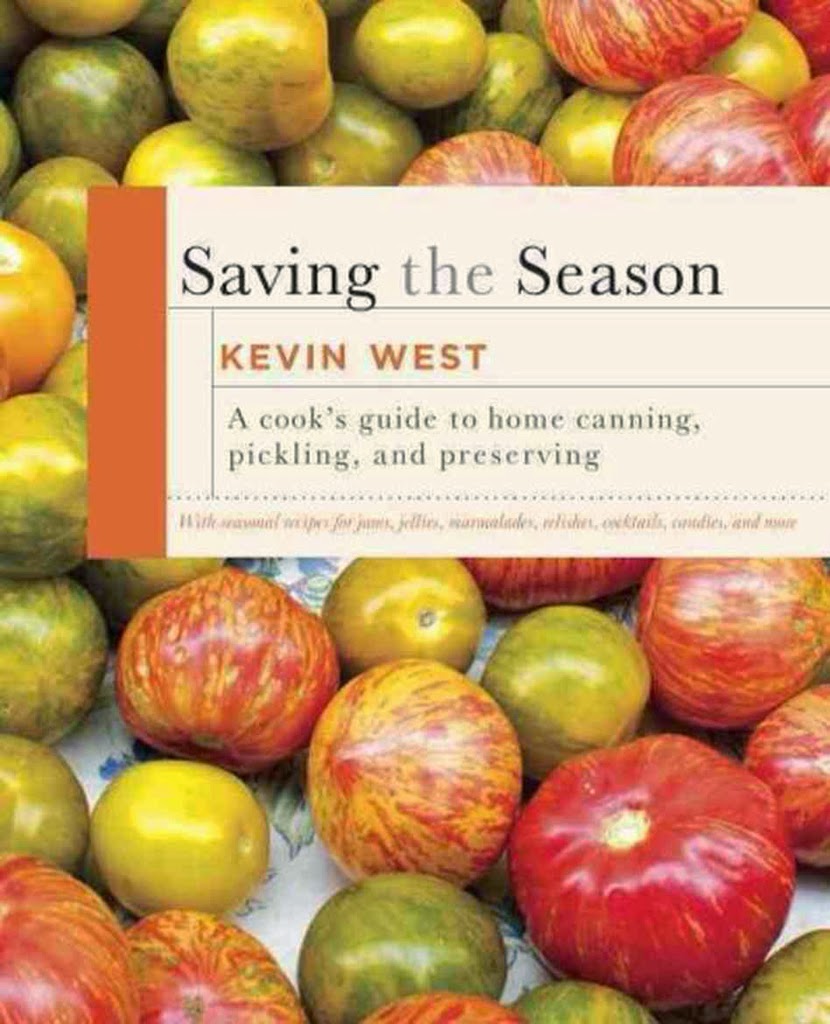
Saving the Season


if there is a preserving book we want it. Like our profound love of French cookbooks, we also covet every preserving book. By now, if you can cook it syrup or douse it in a brine, we have stuffed into canning jars. While most canning books are fine, fun, and full of info, few are comprehensive guides to putting up food. Saving the Season by Kevin West is that comprehensive book.

West grew up in the South and watched his grandmother make jam. Living in California for years, West, was a writer and pretty fine cook. On day he impulsively bought a flat of strawberries and realized that he and his friends could never use them all before they rotted. Holding those strawberries pulled him back to his past, like a powerful sense memory. When he thought of all those years he watched his grandmother make jam, he came to the stark realization that he never really knew how she made the jam. Trying to recreate that flavor, he found recipe after recipe of strawberries covered in sugar, pectin, and boiled. West's reporter side kicked in.


He started studying and cooking and cooking and finally blogging. His blog, Saving the Season turned into an opus of the same name. Yes, Saving the Season will explain how to make jam, jelly and pickles, but it does much more. You will also find:


Lovely photographs

Recipes for using your canning products

Master canners

Food writers

Fiction writers

Poets

Artists

Road trips

An extensive bibliography

An appendix of fruit varieties

An appendix of peak fruit by months


If you have never touched a Ball jar, there is something in this book for you. Ever walked into the kitchen after your friends offer to make margaritias. The drinks were great but there is a huge pile of squeezed lime halves. (you know some of them were not squeezed that well as the drinks went on, so there is a lime juice pooling up.) This is a great recipe to make use of those limes. you don't have to make it right now. Stuff the lime carcasses in a Ziploc bag and wait till the buzz is over.


Limeade Syrup

1/2 pound of lime rinds

2 1/2 cups of water

3 cups sugar

10 coriander seeds

2 cloves

2 allspice berries

Two 1/4-inch slices fresh ginger root

Optional: 1 Kaffir lime leaf and 2 inches lemongrass stalk, crushed

Combine all the ingredients in a saucepan, and simmer for 30 minutes. Strain through a fine-mesh sieve. Store in a sealed bottle in the refrigerator for up to 6 months


We were thrilled to see that Saving the Season was one of Amazon's Best Cookbooks of 2013. It was clearly one of ours.


10 December 2013

The Kinfolk Table

Let's get this out of the way. There are two kinds of people: The people that will LOVE this cookbook and the people that will HATE this cookbook. It is easy to be polarized.
 
Nathan Williams is the editor of the widely popular magazine, Kinfolk.

LOVERS: The magazine's goal is to "offer an alternative idea of entertaining -- casual, intentional, and meaningful."
HATERS: Kinfolk entertaining is tortured, pretentious and devoid of people.

LOVERS: Nathan Williams is a world traveler, collecting recipes.
HATERS: If your world is Portland, Brooklyn, Copenhagen, and the English countryside.
 
LOVERS: The recipes are simple and elegant.
HATERS: The recipes are tedious and don't work.
 
We read dozens of reviews of this book. The glowing reviews all said the book was gorgeous and published a slew of pictures. They waxed poetic about the food, but no one had actually made any of the recipes. The only actual review of the book we could find came from Felicia Sullivan in Medium. She was not a fan.

What do we think?

LOVE IT: If you have ever picked up or for that matter, seen a copy of Kinfolk, you cannot miss it. It is visually arresting. There are few publication out there that one can spot at 100 feet. They love white walls and wooden tables and roasted chicken and so do we. They don't care about immersion circulators or stick blenders or matched china. It is beautiful and we want it for that reason, alone!
 
HATE IT: We love our white walls and wooden table, but we would spend an entire day setting up these photos. They are not just thrown together, they are highly curated. For all the talk of "gatherings" and "community" the photos are hauntingly devoid of people. Most people are alone. The "simple" food is reminiscent of hippie cookbooks from the 1970's. So, in bringing "entertaining" to a new generation, they seemed to have brought mama's old commune coobooks with them.
 
Here's a lentil salad.
Citrus Lentil Salad
1 cup dried green lentils, picked over

6 scallions, white and pale green parts only, thinly sliced

3 tablespoons extra-virgin olive oil

1 tablespoon white wine or apple cider vinegar

3 tablespoons fresh lemon juice

Grated zest of 1 lemon or orange

1 tablespoon sugar

Salt and freshly ground pepper

Rinse the lentils under cold running water in a fine-mesh sieve until the water runs clear. Place the lentils in a medium saucepan and add enough cold water to cover by 3 inches. Bring to a boil, then reduce the heat to medium-low, cover and simmer for 20 to 30 minutes or until the lentils are tender.

Drain the lentils and return them to the pot. Add enough cold water to cover by 3 inches. Remove and discard any lentil shells that rise to the top, then drain once again.

Place the lentils in a large bowl and add the scallions, olive oil, vinegar, lemon juice, zest, sugar, and salt and pepper to taste.

Let the salad rest for at least 20 minutes to allow the flavors to combine. Serve. The salad can be stored,refrigerated, in an airtight container, for up to two days.

The Kinfolk Table is an aspirational cookbook. You aspire to lovely blonde and African children. You aspire to copper pots and a house filled with books. You aspire to poached salmon and steamed cod. You aspire to tattoos and bearded boyfriends in Portland or Brooklyn.
Right now I am sitting at my reclaimed wood table, staring at my stark white wall, drinking coffee, alone. I aspire to the pages of Kinfolk, but I am not going to get dressed or clean off the table for the photo shoot!


06 December 2013

The Little Book of Home Preserving

Preserving books are another of our weaknesses. Really, if you know how to make jam, you really don't need a cookbook. If you don't know how to make jam the vast number of books explaining how to make jam can be daunting. What's a cook to do?


Here's an idea. Grab a copy of The Little Book of Home Preserving by Rebecca Gagnon. It has everything one needs to know about canning a some interesting spins for those of you who can every week. It is the best of both worlds. Yes, it is a little book, but don't let its size fool you. Just because you can slip it into your pocket, might just be a good thing. Ever gone away for the summer and needed to find a reicpe? This book is perfect to toss into your hamper and take on the road.


The recipes are fresh; familiar with a zippy spin. Try the Kumquat-Habanero Marmelade. How about Jicama Apple Cumin Kraut? Or the Citrus Chai Ground Cherry Preserves. She calmly explains that preserving is not always a precise endeavor and she wallks the reader through the vexing variations that occur while canning.

We just love a good shrub, and this one will definitely be on our list.

Elderberry Drinking Vinegar

2 pounds ripe elderberries

1 quart raw apple cider vinegar (such as Braggs)

4 to 6 cups granulated sugar

1. Separate the tiny elderberries from their stems. (An easy way to do this is to place them in the freezer for a half hour and then comb through them with a sterilized, wide-toothed comb.)

2. Place the elderberries in a large glass bowl, crush them gently with a masher, and cover them with the vinegar. Cover tightly with plastic wrap, and store somewhere at room temperature out of direct sunlight for 1 week.

3. Strain the vinegar out of the elderberries into a large bowl, using a fine mesh sieve. Press gently on the berries to help them release all of their remaining juices. The vinegar will be a beautiful purple color.

4. Measure the vinegar and pour into a preserving pot. For every 1 cup of vinegar, add 3/4 to 1 cup of granulated sugar. Over very low heat, stir the vinegar until the sugar melts. (Keeping the vinegar well below the boiling point helps it to remain "raw" and healthful.) Once the sugar is fully dissolved, turn off the heat and remove the pot.

5. Sterilize the jars.

6. Let the drinking vinegar cool completely before storing in sterilized airtight glass bottles or canning jars at room temperature, where it will remain good for one year. To enjoy, pour 2 tablespoons in the bottom of a glass, and top with seltzer or still water.


If you are looking for a niftly stocking stuffer this Christmas,The Little Book of Home Preserving is just the ticket. You can read more from Rebecca Gagnon at her popular blog, CakeWalk.


04 December 2013

Mast Brothers Cookbook

When you look up "hipster" in the dictionary you will find a picture of the Mast Brothers.  They may be the original hipsters, though I am sure there is someone else ready to claim the title.

So here's the story:  Two young boys from Iowa leave to find fortune in the big city.  Tired of working for other people, they look for a creative outlet. They ask a simple question. Where does chocolate come from?  In their spare time they roasted chocolate in there tiny apartment.  They crack the beans by hand and wrapped them in fine papers. The rest is history.

OK, maybe not "history" but surly a moment in hipster history.  The Mast Brothers become obsessed. They immerse themselves in all things chocolate.  The ask more questions.  Why is there no bean-to-bar chocolate available?  How do we get from bean to bar?  Where do we find the folks that grow cacao beans?  After answering these questions, they began selling bars at farmer's markets.

Then one day, while visiting New York, pastry chefs at the French Laundry bought Mast Brothers chocolate.  They were ecstatic and raved to Thomas Keller but it takes more than that to impress Keller.

Keller thought the chefs had found another pair of artisans working at home.  Yes it was good, but could they sustain it.  By the time Keller paid the boys a visit, they had a small factory.  The Midwestern farm boys were strapping, over six feet tall, bearded, looking more like lumberjacks than chocolatiers.
They were no dilettantes, they were the real deal.

And now, they have a cookbook.  Clearly, if you make tons of chocolate, you eat tons of chocolate.  If you eat tons of chocolate, you have good  ideas about how to use that chocolate. The Mast Brothers know how to use their chocolate.

I confess, I adore chocolate.  I also admit that I am not a fan overly sweet chocolate.  I adore chocolate in savory dishes.  I make a winter spice rub with cocoa that makes wonderful chicken and baked squash.  I make squab with a stuffing infused with bits of chocolate.  My favorite bread is made with a chocolate stout and studded with chunks of chocolate.

The average chocolate cookbook has tons to cakes and cookies but few savory elements.   The Mast Brothers Cookbook has the requisite brownies and cakes, but there is a section of savory recipes that make this cookbook special.  Try this vinaigrette.

Cocoa Balsamic Vinaigrette

fresh rosemary                 1/2 sprig
cacao nibs                        1 tablespoon
cocoa powder                   2 teaspoons
sea salt                             2 teaspoons
black pepper                    1 teaspoon
balsamic vinegar              1/4 cup
honey                               2 teaspoons
extra virgin olive oil          1 cup

1. remove rosemary leaves from stem and roughly chop.
2. combine rosemary leaves,nibs, cocoa powder,salt,and pepper and grind in a mortar and pestle.
3. place  ground ingredients in a medium bowl.
4. Add balsamic vinegar and honey and whiskey.
5. Slowly add olive oil while whisking quickly to emulsify.
6. Store in a mason jar in the refrigerator for up to one week.

Who says you can't have your salad and eat chocolate, too?   If there is choco-holic in your house, this is the perfect gift.
Blog Widget by LinkWithin