16 April 2012

13 April 2012
Wood-Fired Cooking

It is clear that I was an arsonist in a previous life. I love fire. I love cooking. So cooking with fire...that is the best.
Let's start at the beginning. In the beginning man cooked meat over an open flame. He survived, so really, how hard can it be? Well, harder than one might imagine. There is fire, but what kind of fire? Charcoal? Wood? What kind of wood? What kind of fire container? There are wood ovens, campfires, grills, big green eggs. Yes, meat is the obvious but what about breads and vegetables and seafood, oh my!
This is where Mary Karlin and Wood-Fired Cooking comes in. She has answers to all these questions. If they are not in the book, there are many answers at her web site, Elements of Taste. There you can also sign up for special cooking classes and find the most eco-friendly charcoal among other things.
Most cooing with wood type books are heavy handed on the barbecue side. Meat, sausage, a rub, a glaze, a sauce, throw in some beans and grilled fruit and there you are. With Wood-Fired Cooking one could just as easily leave out the wood-fired and have a great cookbook. (This is, of course, a bad idea as one would not get the nice char marks and smokey goodness that cooking over fire produces, but I digress.)
The book provides several cooking options depending upon each individual cooking nerd. (I mean that in a nice way, but if you have a roasting box and a big green egg invite me over!) Here is Karlin offering several ways to cook a duck or a chicken.
Tea-Brined Mahogany Duck
Tea Brine
8 cups water
1/2 cup Darjeeling or oolong tea leaves
3 slices fresh ginger
2 star anise pods
1/3 cup soy sauce
1/4 cup honey
Two 3-pound ducks, or one 5-pound roasting chicken
08 April 2012
Passover Cookbook
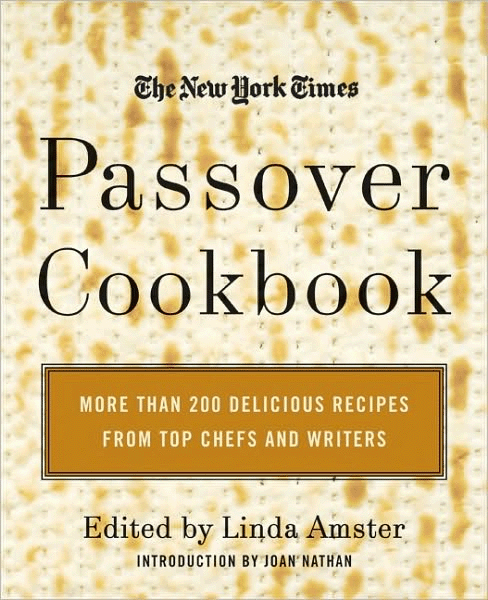 I find it interesting that there are a number of Passover cookbooks but very few Easter cookbooks. Since we have been wishing everyone we know a Happy Easter, we thought we might take this opportunity to offer up a Passover entry. Since we realized we didn't have anything that might fill our Easter Cookbook needs, we thought we might give Passover the spotlight.
Linda Amster culled the New York Times archives to find this collection of great Passover recipes. No I will admit that I have never cooked for a Seder, but I have been to a couple. With this cookbook, it think I might just be able to cook for one. It has been noted that this cookbook features six kinds of haroseth and seven versions of matzoh balls. And so much more. There are recipes from Alice Waters, Charlie Trotter, Wolfgang Puck, and this salmon by Jean-Georges Vongerichten.
Baked Salmon With Basil Oil
4 6-ounce salmon fillets, skin on
1/3cup light olive oil
1cup basil leaves
Coarse sea salt and freshly ground pepper to taste
4sprigs of basil for garnish
1. Preheat the oven to 250 degrees. Season the salmon with a few drops of olive oil and put it on an oiled baking dish.
2. Wash and drain the basil leaves and dry them thoroughly in a salad spinner. Puree them in a blender with the remaining olive oil until smooth. Season to taste with salt and pepper.
3. Bake the salmon for 10 minutes. If the skin peels away easily and the salmon flesh flakes when tested with a fork, it is done even though it may not look it (if you prefer it well done, return it to the oven for three more minutes). Sprinkle the salmon with salt and pepper.
4. Put the fillets on heated individual plates and sprinkle the basil oil in a circle around it. Put a sprig of basil on top of the fish and serve.
Truth is, while these are touted as Passover recipes, they are great for any day of the year.
04 April 2012

03 April 2012
Bought, Borrowed & Stolen

We have been quite fond of Allegra McEvedy since we got a copy of her first book, The Good Cook. McEvedy believes in straightforward cooking with great ingredients. That's it. Since The Good Cook, she may be best known for starting Leon, a healthy, fast-food, restaurant chain, like McDonald's only the Big Mac is butternut squash with lentils. (She has since moved on to other things.)
Bought, Borrowed & Stolen is a cookbook, travelogue, and knife lovers dream. The premise of this cookbook is a bit different and engaging. McEvedy shares recipes from her numerous travels based a a particular knife she procured, legitimately or not, from each culinary adventure. Since the recipes are far flung and a sometimes a bit exotic, they may be a bit more complicated than some of McEvedy's usual fare, but they are worth every story. If there is a drawback to this book, it is the fascination with the knives. It would seem that more ink has been given to the tools rather than the food. And why should we be different. (Seriously, you know we love kitchen gadgets!) So here are some knife facts cribbed from The Guardian and the book.

1. Picnic knife, Turkey
My mum bought this one in a Turkish hardware shop because we were going to have a picnic. It is so basic and has no place among my professional tools, yet I love it because when I hold it, it takes me back to that lunch in the biggest pine forest I had ever seen.
2. Artisan knives, New York
The chap responsible for these beauties is a blacksmith (and ex-farrier), with a suitably grizzly beard for a bloke whose best friend is an anvil. Michael Moses Lishinsky operates under the name Wildfire Cutlery (he actually works out of Oregon). His knives are full tang, which means the metal from the blade extends all the way through to the heel, making them stronger. These are made of heat-treated carbon steel, as opposed to stainless steel, so you have to dry them after use (I oil mine too), but they stay sharper longer.
3. Suction-free, San Francisco
I was sitting at a bus stop between restaurant shifts when I noticed my knife roll had gone. Like the scars on my arms, my knives represented my professional culinary journey. Next payday I went down to Japantown to get my first replacement. I had never seen a knife with holes in it before. The idea is that as you are chopping veg super-fast, the holes help to break any suction, so the slices don't stick to the blade (although I have never noticed them make much difference). I was feeling nervy about knife theft, so I went straight to an engraver's and carved my initials on it.
4. Pig-leg boner, Brazil
As I walked past a hardware shop in Salvador, I was attracted to this by its weird shape. When I got home I took it to my butcher but none of us could see how having the handle so high above the blade helped. When I return to Brazil I'm taking it with me and getting a demo – until then it remains my strangest and least-used knife.
5. Pastry slicer, Morocco
The knife man in the main souk in Marrakech sat on a carpet, surrounded by wood shavings. He carved this one to tackle pastry (especially filo) and cakes and I have found it most useful. Shaped from lemonwood, it is the most pleasing thing to hold.
6. Butcher's Chopper, Hong Kong
As I wandered around a vast indoor market in Kowloon, with about 100 butcher's stalls, I noticed that all of them had this knife. It's a serious butcher's knife, made of wood and stainless steel, with well-balanced weight for one so large.
7. Lorenzi's ceramic knife, Italy
G Lorenzi's in Milan is one of the finest names in sharp implements. Ceramic knives keep their edge much better than steel knives, and with that comes an almost surgical precision (mine is the only straight-edged – as opposed to serrated – knife that I use to slice tomatoes). And they are easier to keep clean as the ceramic doesn't absorb odours as much: I've done the garlic test on that.
8. Unagi-Saki, Japan
In Japanese cuisine, almost every job has a specific knife for it. This one is for cleaning eels.
9. Cleaver, Mexico
I like the mid-size of this cleaver: not as daunting as my enormous Chinese chopper, which I use only for the occasional precision strike. This is in my regular armoury for the way it goes through chicken bones, pork ribs, racks of lamb, even fish steak.
10. Fisherman's Friend, Norway
This is a Scandinavian design classic. It has a Japanese steel blade and is extremely efficient at filleting fish.
11. El Jamonero, Spain
No prizes for guessing what my jamonero is for: all 25cm of it are designed to slice ham. Factory-made by Arcos (a well-known Spanish knife producer), its handle is cool to hold and there is a reassuring weight to it. Slicing this dense meat is suprisingly difficult, but the dimples down both sides of the blade help by letting air in, so less pressure is needed and you can keep your strokes smooth. I like the fact that the Spanish still carve ham by hand.
While the cutlery is impressive, the recipes are also quite grand. We are willing to admit that most of these recipes will never end up on our plate, but just seeing them is enough for us.
Burmese Duck Egg Curry
6 duck eggs
125ml / 4fl oz light oil (such as peanut/grapeseed)
2 banana shallots (or 4 regular), peeled and sliced into thin rings
2 onions, peeled and chopped
½ teaspoon turmeric
2–3 bird's-eye chillies, sliced very small
4 cloves of garlic, finely chopped
½ a thumb of ginger, washed, gnarly bits trimmed (but not peeled), finely chopped
1½ tbps tomato purée
1 tbps curry powder
250g/8oz okra, trimmed and cut into thirds/halved, or little ones left whole
3 medium tomatoes, chopped large
½ tsp shrimp paste (optional but authentic, though if you want to keep it vegetarian just add a bit more salt)
A handful of chopped coriander
SaltBring a pan of water to the boil and carefully lower in the duck eggs. Cook them for 4–6 minutes, depending on size, then drop them into the sink to crack the shells and run them under cold water.
Heat the oil in a wide saucepan. When it's hot, drop in the shallots, breaking them up into rings. Once they are a deep golden brown (5–8 minutes), use a slotted spoon to transfer them on to kitchen paper and sprinkle immediately with salt.
Put the duck eggs into the hot oil and lower the heat. Fry them for 3–4 minutes, turning them to brown on all sides, then take them out of the pan and sit them on kitchen paper, too.
Keeping the pan on a medium heat, add the onions, turmeric, chillies, garlic and ginger and fry for a few minutes, until it all starts to soften, then stir in the tomato purée so that the onion is well covered in it. Cook for a minute or two before adding the curry powder and then stir that in well, too.
Add the okra with a big pinch of salt, followed by the tomatoes, and give it all a good stir. Dissolve the shrimp paste in 500ml of hot water, pour it into the pan and bring to a fast simmer. Let it bubble away busily for around 10 minutes without a lid to reduce, then lower the eggs back into the pan giving them a prod so they are mostly submerged in the liquid. Put the lid on and simmer for just another couple of minutes so that the eggs warm through, then turn the heat off and give it a 3 minute rest.
Finish by sprinkling a little salt on each egg and scattering on the shallots, with roughly chopped coriander on hand to top off each serving.
As someone who may have a ill-gotten knife here or there, I found this book to be great fun. Thanks, again, to The Guardian, we have the opportunity to actually watch Allegra McEvedy cook the above recipe. Check her out.
29 March 2012
Mad Men Cookbook

Actually, it is The Unofficial Mad Men Cookbook as no one wants to get sued by the "official" Mad Men. So after a seventeen month hiatus, the boys are back in town. There is a thriving business in putting together this type of tie-in cookbook. Some of them are just slapped together, but Judy Gelman and Peter Zheutlin have done a wonderful job with this one.
One of the reasons that Mad Men has attained such a cult following is their exacting attention to detail. Creator Matt Weiner says it has become something of a game as viewers look for any little detail that is out of place. (Check out this short Q & A with property manager Gay Perello.) Gelman and Zheutlin have followed Weiner's exacting attention to detail. They have culled recipes from the popular cookbooks of the day as well as from some of the regular haunts of the Mad Men including, "21" Club, Keens Steakhouse, El Morocco, Stork Club, and Trader Vic's.
There are recipes for Pineapple Upside Down Cake featuring the new electric skillet-frypan, Date nut bread from Pat Nixon's contribution to Hints from Heloise, and John Kennedy's favorite daiquiri from Bacardi's "Be A Drink Expert" pamphlet. The book is chocked full of tidbits and facts and recipes that would actually find their way to a Mad Men table.
While definitely retro, The Unofficial Mad Men Cookbook has its own blog filled with more fun Man Men info.
Here is a classic that is still classical...
Caesar SaladWhile I am trying to get used to that fact that there are no more zombies on my Sunday nights, I will say that between Walking Dead and Mad Men the food is definitely better with Don than Shane.
courtesy of Executive Chef Bill Rodgers, Keens’ Steakhouse, New York, New York
For the salad
3 1/2 cups clean, cut romaine lettuce
2 ounces Caesar Dressing (see recipe below)For the topping
1/4 cup finely grated Parmigiano-Reggiano cheese
For the garnish
Raw egg yolk
4 thin slices pimiento
2 anchovy filets, cut in half (4 pieces)
Caesar Croutons (see recipe below)1. Make the salad: Place lettuce in a serving bowl. Toss with dressing.
2. Sprinkle Parmigiano-Reggiano on top, garnish with egg yolk, pimento, anchovy filets, and croutons and toss well.
Caesar Dressing
1 1/2 ounces water
1 ounce lemon juice
3/4 cup canola oil
3/4 cup pure olive oil
1 1/2 ounces red wine vinegar
1 egg yolk
6 peeled garlic cloves
10 Italian anchovy filets
2 2/3 tablespoons finely grated Parmigiano -Reggiano cheese
1/2 teaspoon salt
1/2 teaspoon ground black pepper
1 teaspoons light brown sugar
3/4 tablespoon dry mustard
3/4 tablespoon Worcestershire sauce1. Make the dressing: Combine the water and lemon juice in a measuring cup and set aside.
2. Combine canola and olive oils in a measuring cup and set aside.
3. In the blender, combine the remaining ingredients and mix for 10 seconds. With the blender running, slowly begin to add the combined oils in a slow and steady stream. As you continue to add the oil, the mixture will begin to thicken. When the mixture thickens, thin it out with 1/3 of the water/lemon juice mixture. Repeat this process until all the oil has been incorporated.
4. Chill dressing until cold.
Caesar Croutons
Note: Place the bread in the freezer for 10-15 minutes before slicing to make it easier to cut even squares.
Whole melted butter can be substituted for the clarified butter, but will brown the croutons faster. To make clarified butter, melt 4 tablespoons of butter slowly in a small saucepan. Remove from heat and allow to cool a bit until it separates. Skim off the foam that rises to the top, and gently pour the butter off of the milk solids, which will have settled to the bottom.
6 slices white bread, crusts removed and cut into 1/4-inch squares (see note above)
2 tablespoons clarified butter, melted (see note above)
1 teaspoon chopped fresh herbs (rosemary, parsley and thyme)
1/8 teaspoon Kosher salt1. Pre-heat the oven to 350°F. Toss bread cubes in a bowl with the remaining ingredients.
2. Transfer to a baking sheet and bake for 10 minutes or just until slightly browned and crisp. Let cool at room temperature before serving. Store covered in an airtight container.
Next Week: Peggy is given new responsibility.
26 March 2012
American Gastronomy

Louis Szathmary was a noted chef. He may, however, be more noted as a culinary collector. He donated most of his cookbooks to the University of Iowa, making it one of the leading culinary repositories in the world. Much of the ephemera, including signatures of most Presidents and Firs Ladies went to the Culinary Arts Museum at Johnson & Wales.

Szathmary wrote:
"It isn't strange, then, that I grew up to become a book collector, although I never expected to own some 45,000 of them.Of these, only 18,000 are cookbooks. I remember the first book I bought within a year after coming to this country in 1951 with a small handbag and $1.10 in my pocket. It was at a Times Square bookshop in New York that I purchased, for 19 cents, a little volume by Ludwig Bemelmans. I never stopped buying books since."
Well it is just no wonder that we have a kindred spirit in Louis Szathmary and while we are doing our best to rival his collection, we are no where near his numbers. We do however, have a cookbook or two with his name on them. American Gastronomy is one my favorites. I admit to being a sucker for vintage cooking prints. Szathmary filled American Gastronomy with old prints and vintage recipes from his vast collection. He made a valiant attempt to define food or culinary experience that was truly "American." This was his premise for American Gastronomy, but flipping through the book one finds foods from North to South, East to West that form no quintessential American food experience but the which do reflect the vast nature of American cuisine.
In the end, trying to define American gastronomy as one thing or another simply muddies the water. It would seem that in all his study, he did find a great love of potato salads.
Ham and Sweet Potato Salad
2 cups diced, cooked ham, cut into 1/2 inch cubes
2 cups diced, cooked sweet potato, cut into 1/2 inch cubes
1 cup diced celery, cut in 1/4 inch dice
1 cup apple, cut in 1/4 inch dice
1 cup fresh orange sections
1/4 cup chopped pecans (optional)1 cup mayonnaise.
1. Gently combine all the ingredients, adding the sweet potatoes last to avoid smashing them.
2. Chill and serve in large lettuce leaves.
3. If you wish serve additional mayonnaise.


23 March 2012
Chocolate

As Easter approaches, we dragged out one of our favorite Easter recipes from Linda Collister's Chocolate. Collister has written a series of small books on chocolate. Several of them published by Ryland Peters. We have spoken before of our devotion to books by Ryland Peters. They are small and beautiful books that make food look its most seductive.
Truly, however, it may just be time to grab up all of Collister's "chocolate" books and make one big book. Until then, here is a favorite treat from just plain, Chocolate.
Surprise Eggs
6 very fresh eggs with pretty shells
5 1/2 oz. bittersweet chocolate, finely chopped
1/2 cup minus 1 tablespoon heavy cream
Praline
1/3 cup whole unblanched almonds
1/3 cup whole skinned hazelnuts
1/2 cup sugar
Using the tip of a small, sharp knife, gently cut a small hole in the pointed end of each egg, then carefully snip away the shell with shearers to cut off the top, leaving a hole about 3/4 inch diameter. Empty out the eggs by shaking them over a bowl -- the contents can be saved for omelets or scrambled eggs. Wash out the empty shells thoroughly, then set them on apiece of wax paper in a baking dish and dry them in a preheated oven at 300 F for about 15 minutes. Let cool.
Meanwhile, to make the praline, put the nuts and sugar into a small, heavy saucepan and heat gently on top of the stove. Stir frequently with a wooden spoon until the sugar melts, then watch carefully, stirring frequently, as it cooks and turns chestnut brown, ant the nuts start to pop. Take care with hot caramel, because splashes can burn.
Lift the saucepan off the heat, g quickly pour the mixture onto the oiled baking tray and, using a wooden spoon, spread it out evenly. Leave until completely cold and set, then coarsely break up the praline with a rolling pin or grind it in a food processor.
Put the chocolate into a heatproof bowl. Put the cream into a heavy saucepan, heat until hot but not boiling, then pour it over the chocolate. Leave for 1 minute, then stir gently. Let cool for 5-10 minutes until thick, then stir in the praline. Stand the egg shells upright in an egg carton or rack and carefully spoon the chocolate mixture into the shells. Chill overnight until firm, then remove from the refrigerator 2 hours before serving.
First, we just love recipes that say "1/2 cup minus 1 tablespoon" it is just so confusingly obtuse. Secondly, after one has procured lovely egg shells, spooning chocolate into them will not only make them a mess but well... let's just leave it at that. Grab a Ziplock bag, scrape the chocolate and praline mixture into it and clip off one corner and use that to add the chocolate. It may seem messy at first, but try spooning chocolate into eggs shells and you will see the wisdom.
20 March 2012
Eggs: Book II
 At Lucindaville we were raving about our new chickens. They are still a bit skittish and will not be laying for several months, but they are getting to know their new home.
We are looking forward to lots of eggs, which means looking for new egg recipes. In addition to the chickens we picked up a two volume gem from the 1933 Chicago World's Fair. Eggs featured a volume on egg production and breeding and this volume of recipes.

Book II was a compendium of chicken and egg recipes for the adventurous housewife. Of course the book was ready to teach you how to accomplish that most French dish, the omelet. I was drawn to more fanciful recipes.
The drink section of the book gave up a treasure trove of interesting drinks with the most outlandish of titles. Perhaps because there are just so many uses for eggs, spending the time to invent really lovely sounding names was just too much trouble. My particular favorite is the Albumen Fruit Beverage. Stick that on a menu and see if you have any takers. (Still I am thinking there might just be a Cocktail At The Burn Pit with 'Albumen" in the name.) Then there is the very French Lait de Poule or Hen's Milk. Again, it does not sound that appetizing. But judge for yourself.
Albumen Fruit Beverage
1/2 c. orange or lemon juice
1 egg white
Honey to taste
Beat egg white into a froth, add fruit juice and strain. Sweeten. Serve cold.
Lait de Poule
1 egg
1/2 c. powdered sugar
2 tbsp orange flower water
1 c. boiling milk
Beat the egg, add sugar and orange flower water. Mix thoroughly and add hot milk, stirring as it is added.
19 March 2012
Lidia"s Italy in America

I recently had a birthday and what do you think I got for gifts. I bet you didn't have to think twice. My friend. Anne, gave me a copy of Lidia"s Italy in America. This is a bit funny as this was one of my go to presents this Christmas, but I did not get a copy....until now. Everyone I know loves, loves, loves Lidia. Frankly, I have never had a one of her cookbooks. It seems very strange as I have given copies of her books for many occasions. So now I have my very own copy.
In Lidia"s Italy in America, Bastianich travels the country to find authentic Italian in the four corners of America. If you are of Italian descent, it must be a rush to have Lidia Bastianich show up at your restaurant and watch you cook. Italy is truly in her blood and even if the setting is America, the food is 100% Italian.
Now I have been a great artichoke fan, mainly because they seemed like a huge pain in the ass. But maybe if I started out small...with baby artichokes.
Braised Artichokes
2 pounds baby artichokes (about 16)
8 garlic cloves, crushed and peeled
Zest and juice of 3 lemons
2 tablespoons chopped fresh mint
2 tablespoons chopped fresh Italian parsley
¾ teaspoon kosher salt
¼ teaspoon peperoncino flakes
3 tablespoons extra-virgin olive oil
3 tablespoons unsalted butter, cut into small pieces
1½ cups dry white wine
1 tablespoon dry bread crumbs
To clean baby artichokes and prevent them from oxidizing, fill a large bowl with approximately two quarts of cold water, and add the juice of two lemons, plus the squeezed-out lemon halves.
Peel and trim the stem of the first artichoke. Pull off any tough outer leaves and discard. Using a paring knife, trim away any tough parts around the base and the stem of the artichoke. With a serrated knife, cut off the top third of the artichoke and discard.
Combine the artichokes, garlic, lemon zest and juice, mint, parsley, salt, and pepperoncino in a saucepan of the size in which the artichokes will snugly fit in one layer. Nestle the artichokes in the pan with the ingredients, drizzle with the olive oil, and dot with the butter. Pour 3 cups water and the wine into the saucepan. Bring to a simmer, cover, and cook until the artichokes are tender all the way through, about 40 minutes.
I know what you want to know. Did Anne make me baby artichokes? No! She made a beautiful cassoulet and a chocolate cake!

