14 February 2011

Happy Valentine's Day


For Valentine's Day we thought we would share a recipe from Doe Run Farm. A lovely end to any Valentine's Dinner.


Beet Pie

1 pie crust
2 cup mashed beets
1 cup sugar
1 teaspoon quatre-epice
1/2 teaspoon salt
2 eggs
1 1/2 cups evaporated milk

Combine the the dry ingredients to incorporate the spices evenly.

In a bowl, beat the eggs.

Stir in the mashed beets and the dry ingredients

Add the evaporated milk a bit at a time to fully incorporate

Place your pie shell on a heavy baking sheet

Pour the mixture into your pie shell

Add to a hot pre-heated oven -- 450 -- and bake for 15 minutes

Reduce heat to 350 and bake for about 40 minute


Horseradish Whipped Cream

1 pint whipping cream
1 tablespoon sugar
1 tablespoon prepared horseradish; added a teaspoon at a time to insure you don't over power the cream.


Enjoy.

11 February 2011

The Canapé Book


In 1934, Rachel Bell Maiden wrote the very first book on the canapé, appropriately titled The Canapé Book. Most of the canapés in this little book involve ingredients pulverized into a paste and spread on toast with the occasional shrimp perched atop the paste.

I mean this description to be in no way lax. Maiden not only used her own recipes but she traveled to many a famous hotel to get their recipes for canapés. Here are a couple.

Hotel Gotham, New York

Gourmets
Chopped cooked ham seasoned with mustard and butter, Spread on toasted whole-wheat bread.


Or perhaps this.

The Mayflower, Washington

Yarmouth Canapé

Make a mixture by joining equal amounts of Yarmouth bloater paste (Crosse and Blackwell) and sweet creamed butter. Spread on thin, freshly made graham toast.


Alas, I believe Crosse and Blackwell is no longer in the business of making bloater paste so you will need to buy Shippam's bloater paste.


The most charming elements of the first canapé book are the illustrations by Lucina Smith Wakefield. While a few of them are less than politically correct in today's environment, they are quite eye catching.


So get out there, make some paste and have yourself ...

...of your dreams.

08 February 2011

The Wild Table


What happens when 1960's foraging guide, Stalking The Wild Asparagus hooks up with 1990's darling, The French Laundry? The most attractive love-child -- The Wild Table. Connie Green has been a long time forager who began offering her bounty to chefs in California. Needless to say, they were thrilled. The foraging grew into a flourishing business: Wine Forest, one of the first and largest wild foods companies in America.

Clearly, the more foraging, the more cooking. Connie Green joined forces with Sarah Scott who spent many years as a chef at the Robert Mondavi Winery. Together they have created a cookbook that combines the rustic simplicity of living off the land with the sophistication of fine dining. The mesh is mouth watering. While there is some leeway in substitution, one really should approach this book with the desire to cook the recipes with the actual ingredients. Sure, grilled mushrooms are grilled mushrooms, but an overly simplistic desire to substitute common ingredients for their foraged brethren seems defeatist to the very nature of this cookbook.

Instead, strap on your books and and head out into the woods. (If you are not used to the woods, one might benefit from signing up with a foraging guide to lead your enthusiastic venture. Frankly, you might be surprised just how many people out there participate in such foraging, even in such unlikely places as New York City. But don't expect to find ramps in Central Park. you will need to come to West Virginia for the best ramps.)

So here is a Matsutake mushroom recipe. Make it with Matsutake mushrooms! Seriously.

Foil-Wrapped Matsutake with White Soy and Ginger


3 tablespoons white soy sauce or 2 tablespoons soy sauce plus 1 tablespoon water
2 tablespoons sake
3 tablespoons mirin
1/4 teaspoon freshly grated ginger
1 green onion, white and pale green parts only, finely minced
1/2 teaspoon fresh lemon juice
1/2 teaspoon vegetable or peanut oil, plus more to brush packets
1 pound matsutake mushrooms, cleaned

Whisk together the white soy sauce, sake, mirin, ginger, green onion, lemon juice, and oil in a medium bowl.

Slice the mushrooms lengthwise into 1/4-inch slices. Layout four to six 12-inch square pieces of aluminum foil on a flat surface. Brush the surface of the foil with oil. Divide the mushrooms among the foil squares, fanning the slices slightly in the center of each square. Brush the soy mixture over the mushrooms, enough to coat them generously. Fold in the sides of each packet, then fold the opposite sides together, rolling or tucking in the edges so that the mushrooms are snugly enclosed and the liquid won't leak onto the grill.

Prepare a grill to medium heat.

Place the aluminum foil packets over the heat, fold side up, and cook until they are fragrant and sizzling inside, about 8 minutes. Check inside a packet at this point to make sure the mushrooms are tender. Continue cooking for 1 to 2 more minutes, if needed.

Remove from the grill and let sit for 1 to 2 minutes before serving.

05 February 2011

The Art of Wood Fired Cooking


Andrea Mugnaini didn’t invent cooking on a wood fire but she has become a leading importer of wood fired ovens for home and restaurant use. Since she sells the ovens it is only natural that she offer up instruction on how to cook with one.

Cooking at home on a wood fired oven is much different than an oven that is used by a restaurant. A restaurant oven is typically larger offering more space for different cooking areas. It also has the advantage of being used every day, so starting the oven and maintaining a even cooking temperature is much easier than a home oven that may be lighted only for a weekend.


After years of working and teaching others how to cook in their wood oven, Andrea Mugnaini has taken the tricks that she has perfected and collated them for the novice wood oven cook.

The book has that we-live-like-Italians-in-Napa lifestyle vibe to it. (Not that pretending to be Italian at my house with the big wood-burning oven in the Napa Valley would be a bad thing.)


You have to hand it to Andrea Mugnaini, she doesn’t spend a lot of time trying to force you buy one of her ovens. She clearly states that if you have the book, you probably have a wood-burning oven. Frankly, the book is way cheaper than a Mugnaini Oven, so if you don’t have one, just cook in the fireplace. Mugnaini also points out that there is no “specific” recipe to cook in a wood burning oven, that most anything can be converted to cook in such an oven. Conversely, most any of the recipes in The Art of Wood Fired Cooking can be tweaked to cook in an oven, though they will be lacking in the lovely char and smoke of wood heat.

Now, part of having that Italian/Napa vibe is the need to make great, unfussy, lovely food. There are no foams, or complicated sauces. The food is painfully fresh and straight forward, and this is one of the best.

Wood-Roasted Butterflied Shrimp

2 pounds large shrimp, shell on
1 teaspoon sea salt
1 teaspoon lemon zest
3 tablespoons lemon juice
2 tablespoons olive oil

Remove the shells up to the tail segment and remove the vein from the shrimp. Cut through the shrimp to open like a book, being careful not to cut all the way through. Repeat until all the shrimp are butterflied.

Place shrimp in a medium bowl and add the remaining ingredients; toss together. Cover and refrigerate for 1 hour. Remove from the refrigerator and place onto a sheet pan, cut side down with the tail curled over the shrimp. Place in the oven and roast 3-5 minutes or until pink and firm to the touch.


There is a problem. If you do not have a wood burning oven, my advice is not to buy this book, because the second you start looking at the recipes, you will be understandably tempted to get a wood burning oven for your yard, whether your yard is in West Virginia, Alabama or even the Napa Valley. Don’t say I didn’t warn you.

04 February 2011

Cooking for Many


Most cookbooks offer up recipes for serving two or four or six, but few cookbooks provide recipes for large events. Longtime cookbook author, Charlotte Turgeon, filled to void of a cookbook to feed larger crowds from 10 to 200 in her book Cooking for Many.

Cooking for Many is divided up in the way you might think it would be, in menus for special occasions such as Christmas and weddings. Each menu features a nifty shopping list, so when you out and about trying to make casseroles for 200 you won’t forget to pick up the bay leaves or sherry.

Since the recipes call for large amounts, many of the recipes transpire over several days or take on an interesting approach of diving the recipe into a “sooner” and “later” division of time for such involved undertakings.

This is an offering for a church gathering. I can remember eating a lot of turkey tetrazinni or “tetrazzone” at many a church gathering, though I am quite sure that it was never made in such a large quantity. But if I ever need to whip up a batch for 200, I know just what to do.

Turkey Tetrazzone

2 20-pound turkeys
1 bunch celery
1 pound carrots, sliced
6 large onions (1 1/2 pounds)
12 cloves
3 tablespoons salt
12 peppercorns
4 bay leaves 1 teaspoon thyme
20 pounds egg noodles

Sauce:

2 1/2 pounds margarine
3 pounds (12 cups) flour
2 gallons turkey broth
2 gallons milk
1 1/2 teaspoon nutmeg
6 tablespoons salt
2 tablespoons white pepper
3 cups sherry
10 8-ounce cans sliced mushrooms
1 pound grated Parmesan cheese
large bunch parsley

First Day: Place each bird, which has been quartered by the butcher, into a large kettle. Cover with cold water and bring to a boil, skimming off any matter that comes to the surface. Divide the seasoning between the two kettles, sticking the cloves in the onions. Poach the turkeys for 3 hours or until tender but not over-cooked. Remove to large pans. Peel off the skin and put it back in the kettles, and boil down the stock until there is a little more than a gallon in each kettle. Strain into one large kettle. Cool and refrigerate the broth and the turkey overnight.

Second day: Skim off the coagulated fat from the top of the broth and heat the broth along with the milk in a large kettle. Heat margarine in another kettle but do not let it brown. Remove from the fire and stir in the flour. When well mixed, add I gallon of the hot liquid and stir until well blended.
Add the seasonings and sherry. Simmer over low heat for thirty minutes. Taste for seasoning.

Using as many kettles as feasible, cook the noodles – not more than 2 pounds at a time in one kettle – in large amounts of boiling salted water for 6 minutes. Run cold water over the cooked noodles.

During these procedures, the cook’s assistant should be boning the turkey and cutting the meat into thin strips.

Drain the mushrooms.

Arrange 20 2-quart casseroles on the working counter. Into each casserole put a 2-inch layer of noodles. Cover with a layer of turkey and pour 2 cups of sauce over it. Repeat. Spread a thin layer of mushrooms on the last layer of sauce, cover with a film of sauce, and sprinkle with cheese. Cover and store overnight in the refrigerator.

Serving day: Bake each casserole for 1 hour at 375 F. Reduce the heat to 200 if the casseroles need to be kept warm. Garnish each with a small bouquet of parsley before serving.

If you are planning to feed a big crowd for the Super Bowl, this should help you out. But you need to start today or you won't have it on the table by Sunday.

02 February 2011

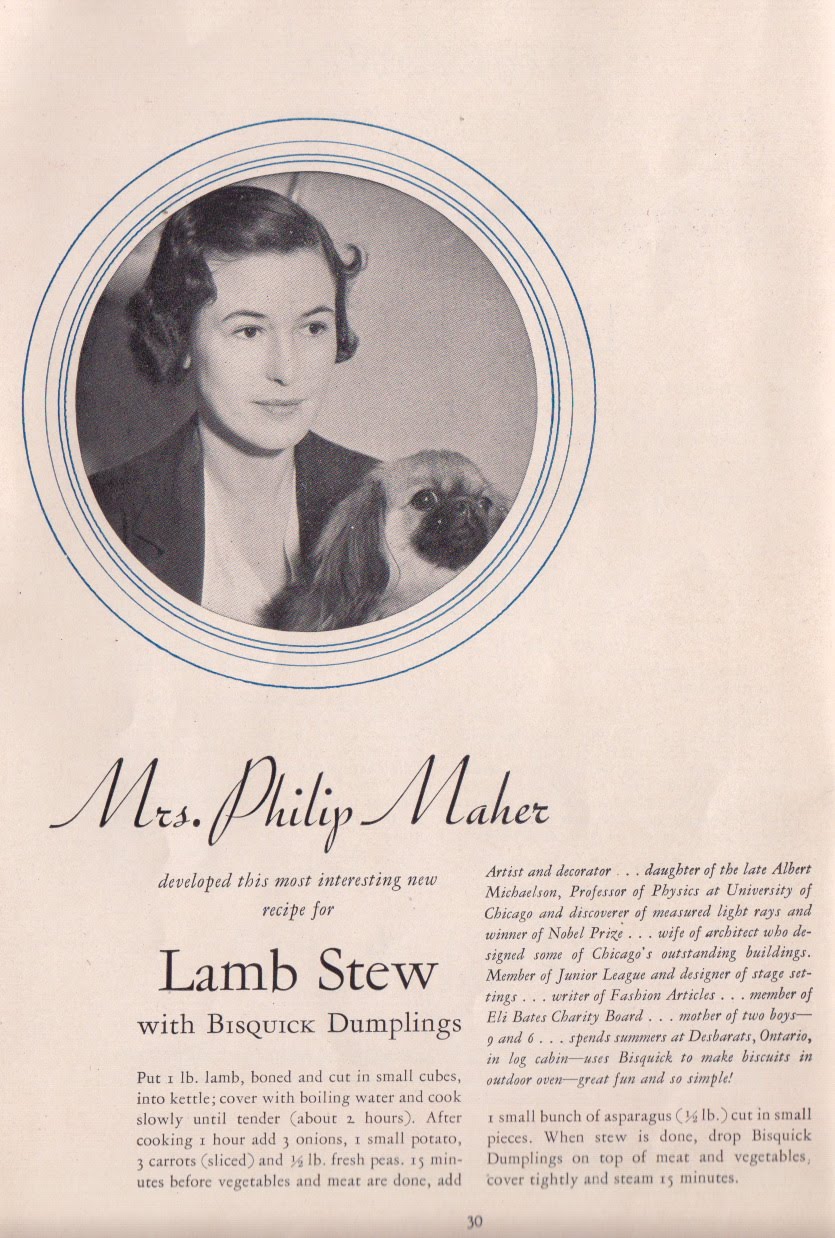
Betty Crocker’s 101 Delicious Bisquick Creations


Betty Crocker’s 101 Delicious Bisquick Creations


Southerner’s love their Bisquick. I love my Bisquick. I am convinced that there is no better way to make pancakes. The house specialty at Doe Run Farm is our famous 3 "B" Pancakes – Buttermilk Bisquick and Bacon Pancakes.


Bisquick is also great for biscuits, scones, dumplings, and even shortcake.


Since I have a great affection for Bisquick, I am please to share with you this little pamphlet from 1933. It seems that I am not the only one who loves their Bisquick. Fashionable hostesses from New York to Chicago to Los Angles are also big fans as well as some big box office stars.


I can’t tell you how happy I am to find that Gloria Swanson was home making cheese biscuits with little more than a box of Bisquick and some grated cheese.


It seems the Comtesse de Fries of New York and Palm Beach loves her Bisquick waffles. Here is how she makes them:

Waffles

2 cups Bisquick
1 1/2 cups of milk
2 eggs
2 tbsp. melted butter (if desired)

Beat eggs well with rotary beater. Add milk and Bisquick. Beat with the egg beater to mix batter very thoroughly. Mix in the butter if a richer waffle is desired. Pour into hot waffle iron (3 tablespoons of batter make 1 waffle). Bake until golden brown. To get a crisp waffle the waffle iron must be very hot.


Now the truth be told, you can assemble a fine substitute for store-bought Bisquick. In fact rumor has it that Bisquick got its stat when a sales executive watched a train porter pre-mix flour and shortening for a quick way to make biscuits. So if you are feeling a bit like a porter today, try this:

Train Porter's Baking Mix

9 cups all-purpose flour
1/4 cup baking powder
1 tablespoon salt
2 cups shortening

Mix to a fine crumble and store in a cool, dry place. Some folks add a tablespoon of sugar to the mix.


Either way you and the porter and Gloria will be having a wonderful time baking away.

31 January 2011

Dinner On A Toothpick


Dinner on a Toothpick is a guide to feeding 4 to 40 without forks. Since the Superbowl is at hand, this little gem from 1971 is filled with bites to skewer on a toothpick, so an easy guide for appetizers.

Written by Josephine Camille and Gail Johnson this little book is meant to be an introduction to “casual dining” or more specifically a way to serve up a cocktail buffet. It does seem a bit curious that there has been so much recent interest in cocktails but not so much in cocktail snacks.

Dinner on a Toothpick is chocked full of balls. Beet balls, olive balls, bourbon balls and of course meatballs. There is nothing earth shattering about the appetizers featured in the book. It does have a nifty chart in rear of the book that features a chart for every appetizer in the book listing among other things whether it is hot or cold, hearty or secondary, bland or spicy and whether it could be made in advance.

Since balls are easily skewered and since everyone likes a little dessert, her is how to make bourbon balls.

Bourbon Balls

1 cup vanilla wafers, rolled fine
2 jiggers bourbon
2 tablespoons cocoa
1 cup pecans or walnuts, finely chopped
1 1/2 tablespoons white corn syrup
powdered sugar

Mix all the ingredients and form into small balls. Roll in powdered sugar. May be stored in a jar in the refrigerator.


How easy is that?

20 January 2011

Purefoy Hotel


We did a post on the famous Purefoy Hotel Cookbook. I once read this from a book dealer: Frankly, I'm not quite sure how this book became one of the most sought-after cookbooks in America, but it is! So true.

People are often asking me if they can buy my copy. Some people collect the various editions and every time I mention it, I get e-mails from people.

Recently I got an e-mail from Alan Anderson. He told me his parents always stopped in at the Purefoy twice a year. He wrote:

"My mother's recipe book is very well used, dog eared would be an understatement. There is a menu she kept in the book."
He sent me a copy of his mother's old menu from the Purefoy that she had kept tucked in her copy of The Purefoy Hotel Cookbook.

There is no better reason to do a blog.

Thanks, Mr. Anderson

14 January 2011

Southern Ground


I love Southern Ground. Now I know you know I love Southern cookbooks. And you probably know I love tunes, especially that Americana/y’alternative rooted in the South. Southern Ground is a cookbook written by a fave band, the Zac Brown Band.

Now Zac can sing and he can cook.


I love Southern Ground for another reason – it is a great and unusual design. Instead of heading out to a mainstream publisher, they chose a different route. Printed on heavy card stock, every double page spread features pictures and writings by the band and a recipe. Each recipe is printed on a white 3 x 5 recipe card tucked into a glassine envelope. It’s the kind of book a mainstream publisher would dismiss as a hassle.


The recipes are standard Southern fare, greens, Brunswick Stew, deviled eggs, stewed okra and of course…

Sharp Cheddar Pimento Cheese

1 lb sharp cheddar cheese, medium grated
1/2 bunch green onions, chopped
1 (4oz) can roasted red pepper, dices
3/4 cup prepared mayonnaise
6 oz cream cheese, room temperature

Grate sharp cheddar cheese into a large bowl.
Add all ingredients and mix well. You won’t need salt because of the sharp cheddar has enough.


The best news...this is Volume 1. Check out a copy at the Zac Brown Band web site.

12 January 2011

High On The Hog


To say that Jessica B. Harris writes “cookbooks” would be a grievous understatement. She does write cookbooks but she a masterful practitioner of culinary history. There is that derogatory adage which states those who can do and those who can’t teach. Jessica B. Harris can both cook and teach.

Here new book was receiving accolades even before it was officially published. High on the Hog is a narrative of African American foods history told from one table to another.

It is easy to forget that the African Diaspora brought with it many of the foodways that most people think of as truly American. When looking at one of America’s earliest and most influential cookbooks, 1824’s Mary Randolph’s The Virginia House-wife, featured ingredients that simply hadn’t existed in America a hundred years earlier such as field peas and okra. It would be three years later when the first African-American published a book with recipes, Robert Roberts’ The House Servant’s Directory.

It would be inconceivable to think that there is a person interested in American cuisine and Southern cuisine especially, that wouldn’t benefit from a careful reading of Jessica B. Harris’ High On The Hog.

Though there are only a few recipes in her book, this one from her Grandma Harris is sure to be a winner.

Grandma Harris’s Greens

4 pounds of mixed collard, mustard, and turnip greens
8 strips of bacon
6 cups water
Salt and freshly ground black pepper to taste

For serving:
Hot sauce
Chopped onions
Balsamic vinegar

Wash the greens well, picking them over to remove any brown spots or blemishes, then drain them well, cut out the thick central stems, and tear the greens into bite-size pieces. Place the bacon strips in a large, heavy saucepan and cook them over medium heat until they are translucent and the bottom of the pan is covered with the rendered bacon fat. Add the greens to the water and bring to a boil over medium heat. Reduce the heat to low and continue to cook, covered, until the greens are tender – about 2 hours. Add salt and pepper to taste.

Serve the greens hot, accompanied by hot sauce, chopped onions, and vinegar.


Harris notes that some cooks added a pinch of sugar but not her Grandma. Bless her heart, my Great-Aunt Mamie, who was in charge of cooking the greens in our house would never add sugar, either.
Blog Widget by LinkWithin